Tourism Jobs Need to Be Measured Beyond Headcounts
Tourism can create work across accommodation, food, transport, retail, and attractions, but a low unemployment rate does not tell us whether those jobs are stable, fairly paid, or protected. Here is how to assess tourism livelihoods in Gunungkidul.
A job count is only the beginning
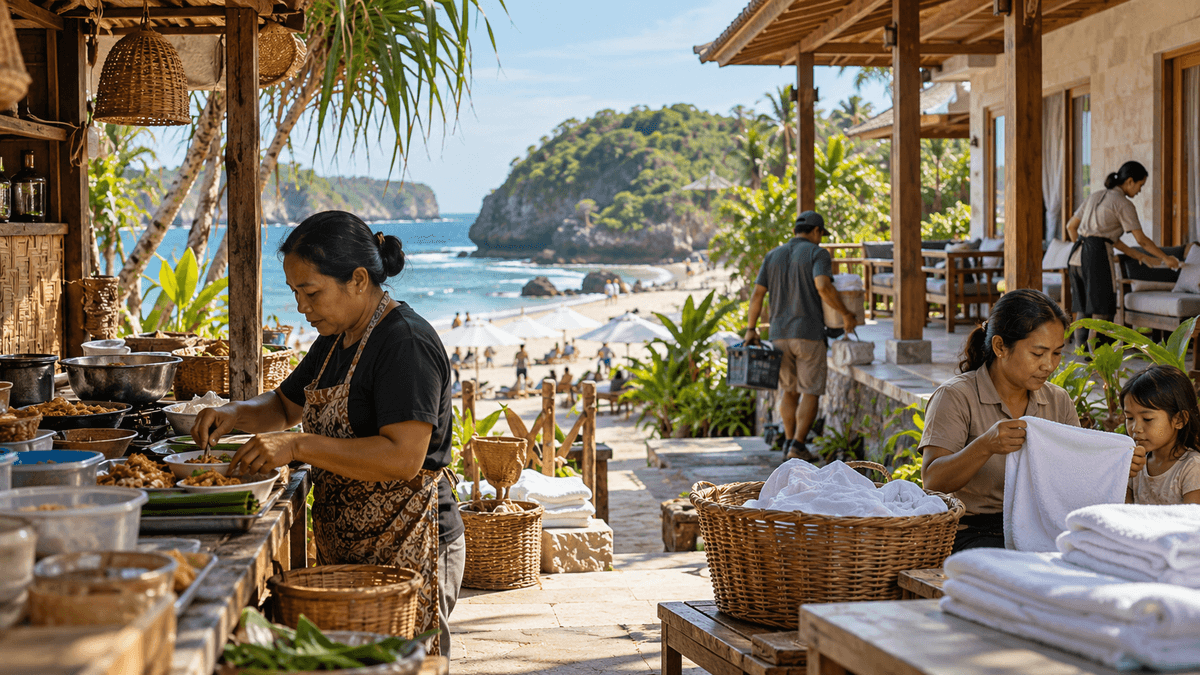
Tourism is often promoted as a source of employment. In Gunungkidul, visitor demand can support people working in accommodation, restaurants, transport, attractions, retail, guiding, equipment rental, and food or craft production. It can also create opportunities for family businesses and informal sellers. But counting jobs, or pointing to a low unemployment rate, does not tell us whether those opportunities provide steady and adequate livelihoods.
Statistics Indonesia (BPS) reports Gunungkidul’s open unemployment rate (Tingkat Pengangguran Terbuka, or TPT) at 2.15% in 2025, compared with 2.16% in 2024 and 2.09% in 2023. The published 2025 rate for the Special Region of Yogyakarta (DIY) was 3.46%. These figures describe open unemployment under the statistical definition; they do not identify how many jobs are tourism-related, how much tourism workers earn, or whether workers have predictable hours and social protection.
The official rate is available in BPS’s open unemployment table by regency/city (opens in a new tab) and in the regency’s 2025 performance report (opens in a new tab). It is important labor-market context, not a tourism employment count.
Tourism work is spread across industries
Tourism is not confined to hotels or attractions. A person may earn income by driving visitors, selling fish to restaurants, supplying vegetables, cleaning rooms, maintaining facilities, producing souvenirs, managing bookings, or providing technical services. Some jobs are in businesses directly serving visitors; others are in suppliers whose customers include residents and firms from many sectors.
That creates a measurement problem. Counting all workers in accommodation and food services as tourism workers would overstate tourism employment because those businesses also serve local customers. Counting only workers employed by destinations and hotels would understate the wider chain because it would exclude relevant transport, retail, food production, and other supplier jobs. The answer depends on the definition used and the purpose of the estimate.
A useful measurement approach distinguishes tourism industries, tourism-related occupations, and jobs supported by visitor demand. These are overlapping but not identical concepts. A transparent estimate should state which one it measures, how it treats part-time and seasonal workers, and whether it counts jobs, people employed, or full-time-equivalent positions.
Job quality can matter as much as job availability
The International Labour Organization (ILO) has highlighted persistent challenges in tourism and hospitality work internationally, including seasonality, informality, variable or long working hours, low wages, and gaps in social protection. These are sector-wide risks, not proof that every tourism job in Gunungkidul has those conditions. They identify issues that local data should investigate.
For a worker, a job that exists only during peak holiday periods may not provide the same security as year-round employment. A small business owner may earn income but also carry the costs and risks of equipment, stock, weather, visitor fluctuations, and repairs. A household can earn from tourism and still remain vulnerable if income is unpredictable or if the household must pay high transport, housing, or business costs.
The central question is whether jobs provide sufficient earnings, safe conditions, skills development, and a realistic path to more stable work. Good tourism policy should also account for people who work informally or operate family businesses and may not appear clearly in conventional employer statistics.
Indicators that would show whether livelihoods are improving
Gunungkidul could publish a tourism-livelihood scorecard using a small, consistent set of measures. Data collection could combine establishment surveys, worker surveys, local labor statistics, and procurement records. The scorecard should distinguish official statistics from new survey estimates and report the period covered.
Useful indicators include:
- Employment reach: number of workers by tourism-related activity, employment status, gender, age group where appropriate, and village or destination area. Definitions should prevent double-counting people with multiple jobs.
- Earnings and hours: median earnings, hours worked, overtime, paid leave, and variation between peak and off-peak months. Median values are often more informative than a mean dominated by a few high earners.
- Employment stability: contract or work arrangement, months worked per year, seasonality, turnover, and the share of workers with social security or other applicable protections.
- Business ownership and viability: local ownership, enterprise size, survival, access to finance, and whether owner income remains after operating costs.
- Skills and progression: access to paid training, recognized skills, supervisory opportunities, and pathways from casual or entry-level work to more secure positions.
- Local supply-chain participation: the number and value of purchases from local farms, fisheries, craftspeople, and service providers, where businesses can report this reliably.
The purpose is not to create a cumbersome reporting burden for small firms. A stratified survey, proportionate reporting requirements, and periodic publication of aggregated data could reveal trends while protecting business confidentiality and worker privacy.
Improve jobs by improving the system around them
Better tourism livelihoods require more than training workshops. Training can help workers develop language, safety, service, digital, accounting, food-handling, and management skills, but it cannot by itself create steady demand or improve bargaining power. Businesses need access to markets, reliable infrastructure, clear rules, and workable finance. Workers need predictable terms, fair payment, and meaningful routes to raise concerns.
Local procurement can spread opportunity, provided suppliers can meet quality and delivery requirements and are paid on time. Destination operators can make peak and off-peak staffing more predictable by planning maintenance, training, events, and product development across the year. Public agencies can improve job matching by coordinating employers, vocational institutions, and local job seekers around actual hiring needs rather than training for assumed vacancies.
These measures should be evaluated against outcomes as well as participation counts. The number of people attending training is an input; improved earnings, safer work, lower turnover, or higher job stability are outcomes. Similarly, an increase in business registrations does not by itself establish that livelihoods have improved.
Low unemployment says little about decent work
Gunungkidul’s 2.15% open unemployment rate in 2025 is a useful indicator. It cannot tell us whether tourism workers make a living wage, whether women and young workers have equal access to advancement, whether earnings disappear outside the holiday season, or whether the value of tourism reaches small businesses and their workers.
If the regency wants tourism to strengthen local livelihoods, it needs to measure both access to work and the quality of that work. Publishing a reliable tourism employment estimate, alongside wage, stability, protection, and supplier indicators, would make the debate more concrete. It would also help authorities distinguish a destination that is merely busy from one that creates durable opportunities for its residents.
Sources consulted
- BPS-Statistics Indonesia, Gunungkidul. “Tingkat Pengangguran Terbuka (TPT) Menurut Kabupaten/Kota” [Open unemployment rate by regency/city]. 2025 data table, updated 4 December 2025. https://gunungkidulkab.bps.go.id/id/statistics-table/2/OTMjMg==/tingkat-pengangguran-terbuka-tpt-menurut-kabupaten-kota.html (opens in a new tab). Accessed 25 October 2026.
- Pemerintah Kabupaten Gunungkidul. Laporan Kinerja Instansi Pemerintah Kabupaten Gunungkidul Tahun 2025 (LKjIP 2025) [Gunungkidul Regency Government Performance Accountability Report 2025]. Published January 2026. https://gunungkidulkab.go.id/wp-content/uploads/2026/01/LKJIP-2025.pdf (opens in a new tab). Accessed 25 October 2026.
- International Labour Organization (ILO). “Tourism Jobs in the Aftermath of the Pandemic: Skills and Labour in Short Supply.” Published 26 September 2025. https://ilostat.ilo.org/blog/tourism-jobs-in-the-aftermath-of-the-pandemic-skills-and-labour-in-short-supply/ (opens in a new tab). Accessed 25 October 2026.
- International Labour Organization (ILO). “Tourism, Hotel and Food & Beverage Services.” https://www.ilo.org/topics-and-sectors/industries-and-sectors/tourism-hotel-and-food-beverage-services (opens in a new tab). Accessed 25 October 2026.
Keep reading
This article is part 5 of 12 in the series "Gunungkidul's Tourism Economy, Explained".
- Previous: Follow the Rupiah: How Visitor Spending Can Multiply in Gunungkidul
- Start of the series: Gunungkidul’s Economy Is Growing. How Much Comes From Tourism?
Related articles: