Follow the Rupiah: How Visitor Spending Can Multiply in Gunungkidul
A visitor’s payment can support a restaurant, its workers, a farmer, a fisher, and other suppliers, but only if the money moves through local businesses. Learn how the tourism multiplier works, where value can leak out, and what local sourcing can change.
A tourism payment can start a chain of local transactions
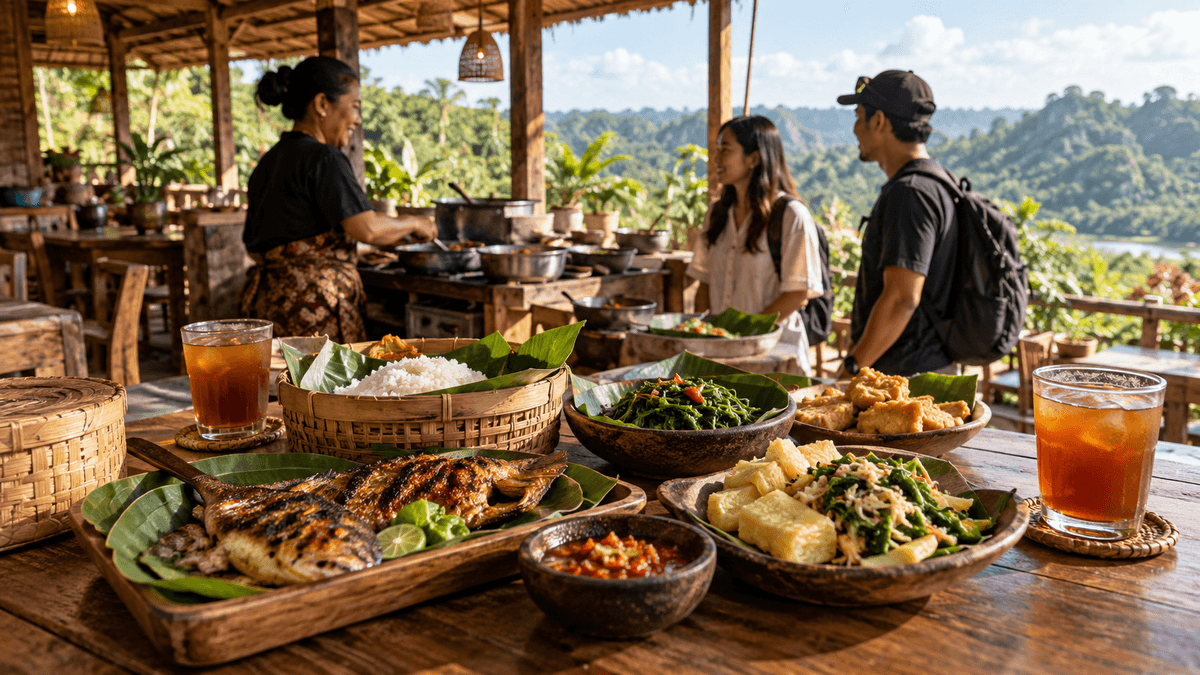
A visitor buys lunch near a beach in Gunungkidul. The seller uses part of the payment to buy fish, vegetables, cooking oil, gas, packaging, and other supplies. The stall pays a worker, maintains equipment, and may buy cleaning or transport services. The fish seller, farmer, and worker then spend some of their own income. One visitor’s purchase can therefore support more than the business that received the first payment.
Economists describe these connections through direct, indirect, and induced effects. Direct effects arise in businesses serving visitors. Indirect effects occur when those businesses buy from suppliers. Induced effects occur when workers and business owners spend income earned through the activity. The combined chain is often called a tourism multiplier.
The concept is useful, but it is not a magic number. A multiplier depends on the structure of the local economy, the goods and services supplied locally, the ownership of businesses, imported inputs, wage and profit flows, and the method used to calculate the effect. A figure from another country or region cannot simply be applied to Gunungkidul.
Start with the spending evidence and its limits
The Gunungkidul Tourism Office reported average visitor spending of IDR 579,118 per visit in the second quarter of 2026. The same official release reported an average visit duration of 1.27 days. For domestic visitors, it reported average spending of IDR 548,512 per visit and an average duration of 1.13 days. These figures are useful signals of reported visitor expenditure, not a direct measure of the income that remains in the regency.
The release is available on the Gunungkidul Tourism Office website (opens in a new tab), published on 7 August 2026. The public summary does not give a full sampling frame, sample size, weighting procedure, or confidence interval. Its averages should therefore be described as the agency’s reported survey estimates, not as a census of every visitor or a precise measure of net local benefit.
A spending average also does not reveal who receives the money. A visitor might spend IDR 579,118 on a mix of food, transport, tickets, accommodation, and retail, but the local share depends on where each item is purchased, which supplies the seller buys, who owns the business, and where the income is paid or spent. A local-looking transaction is not automatically a fully local value chain.
Where the money can stay or leave
Consider three possible routes for visitor spending.
A locally connected route. A restaurant buys produce from a Gunungkidul farmer, fish from a local fisher, and services from a nearby repair business. It hires residents and pays them on time. In this case, a visitor’s payment can support several local enterprises and households. The money may circulate again when those recipients shop or hire other local services.
A mixed route. A destination buys some ingredients and services locally but sources beverages, equipment, packaged products, booking services, or specialist maintenance from outside the regency. Local workers still benefit, but part of the original spending leaves the area to pay external suppliers. This is not automatically a failure: outside suppliers may be necessary for quality, scale, safety, or cost. The analytical question is how much local value can be retained without compromising service or efficiency.
A high-leakage route. A business relies heavily on external supplies, external management, nonlocal ownership, or platforms and service providers outside the area. Visitors may spend substantial amounts at the destination while a smaller share becomes local wages, purchases, and profits. That pattern cannot be diagnosed from visitor counts or the gross value of sales alone; it requires information on procurement, costs, ownership, and labor.
These routes illustrate mechanisms, not claims about the measured share of spending currently retained in Gunungkidul. A defensible local retention estimate would need data on the spending basket and the origin of the goods, services, wages, and ownership income supported by that spending.
The difference between sales and local value added
Suppose a visitor spends IDR 100,000 at a food business. It would be incorrect to say that Gunungkidul gains IDR 100,000 in local income automatically. The business may spend part of that amount on ingredients, energy, rent, transport, packaging, and other costs. Some of those inputs may be locally produced; others may be sourced elsewhere. The remaining value supports wages, operating surplus, taxes, and other uses under different accounting definitions.
Adding a business’s sales to the supplier’s sales without accounting for the same inputs can count the same economic activity more than once. This is why a regional multiplier needs a defined method and data, rather than an intuitive calculation from receipts. The OECD’s 2024 working paper on international tourism uses input-output tables to trace the supply chains behind visitor demand. Its results describe an international data framework, not Gunungkidul’s local multiplier. The OECD paper (opens in a new tab) helps explain the method, but should not be quoted as a local estimate.
How destinations can strengthen local links
Local value retention is not achieved simply by telling visitors to “buy local.” Businesses need reliable products, quality standards, predictable supply, workable prices, and payment terms that do not undermine small suppliers. Useful steps include:
- Build a supplier directory that records product type, capacity, quality standards, delivery areas, seasonality, and contact details for local farms, fisheries, food producers, craftspeople, and service providers.
- Help small suppliers meet the packaging, food-safety, consistency, invoicing, and delivery requirements that larger tourism businesses need.
- Encourage buyers to share realistic forecasts and purchase specifications, so suppliers can plan production and avoid investing in capacity without a credible market.
- Develop aggregation or cooperative logistics where individual producers cannot meet the volume or delivery schedule required by a business.
- Track procurement by supplier location and value, while protecting confidential commercial information.
- Pay invoices on agreed terms. Local sourcing provides limited benefit if small suppliers must finance long delays from their own cash flow.
These interventions are more practical than an unsupported claim that tourism already generates a particular multiplier. They target specific frictions that can prevent local firms from entering the supply chain.
Measure the links between businesses as well as the crowds
A useful local study would sample tourism businesses across different types and sizes, collect purchasing data by input category and supplier location, and record employment, wages, and ownership. It should define what counts as “local,” cover peak and off-peak periods, and avoid adding sales and supplier turnover as if both represented new value. The study could estimate direct local value added and, if the input-output data are adequate, broader indirect effects.
The results should be published with assumptions and confidence limits. Where the data is too weak to support a multiplier, publish the more reliable descriptive indicators instead: the share of procurement from local suppliers, number of active local suppliers, local employment share, average wages, and payment times. These are not substitutes for a full multiplier, but they can show whether local connections are becoming stronger.
The real objective is a stronger local economy
Visitor spending is an opportunity, not a guarantee. The economic benefit depends on how much demand reaches local businesses, how those businesses purchase and hire, and whether workers and suppliers can keep a fair share of the value they help create.
For Gunungkidul, the next question should not be only how much visitors spend. It should also be which local enterprises are connected to that spending, what prevents others from joining the chain, and whether better local procurement can increase income without raising prices or lowering quality. That is how the multiplier concept becomes a practical development agenda rather than a slogan.
Sources consulted
- Dinas Pariwisata, Ekonomi Kreatif, Pemuda dan Olahraga Kabupaten Gunungkidul. “Belanja Wisatawan Gunungkidul Triwulan II 2026 Capai Rp579.118 per Kunjungan” [Average visitor spending in Gunungkidul reached IDR 579,118 per visit in Q2 2026]. Published 7 August 2026. https://wisata.gunungkidulkab.go.id/belanja-wisatawan-gunungkidul-triwulan-ii-2026-capai-rp579-118-per-kunjungan/ (opens in a new tab). Accessed 25 October 2026.
- OECD. Estimating the Global Economic Impacts of International Tourism. Published 20 December 2024. https://www.oecd.org/en/publications/estimating-the-global-economic-impacts-of-international-tourism_a978348f-en.html (opens in a new tab). Accessed 25 October 2026.
- World Bank. Indonesia Tourism Development Project: Project Appraisal Document. Published 2018. https://documents1.worldbank.org/curated/en/839781527910281861/pdf/Indonesia-Tourism-PAD-05102018.pdf (opens in a new tab). Accessed 25 October 2026.
Keep reading
This article is part 4 of 12 in the series "Gunungkidul's Tourism Economy, Explained".
- Previous: Tourism Revenue Is Not the Same as Tourism’s Total Economic Value
- Start of the series: Gunungkidul’s Economy Is Growing. How Much Comes From Tourism?
Related articles: