Can Tourism Fees Help Fund Conservation in Gunungkidul?
Tourism fees can support public services, but revenue does not automatically become conservation funding. Any mechanism needs a legal basis, transparent allocation, measurable outcomes, and safeguards for lower-income visitors and residents.
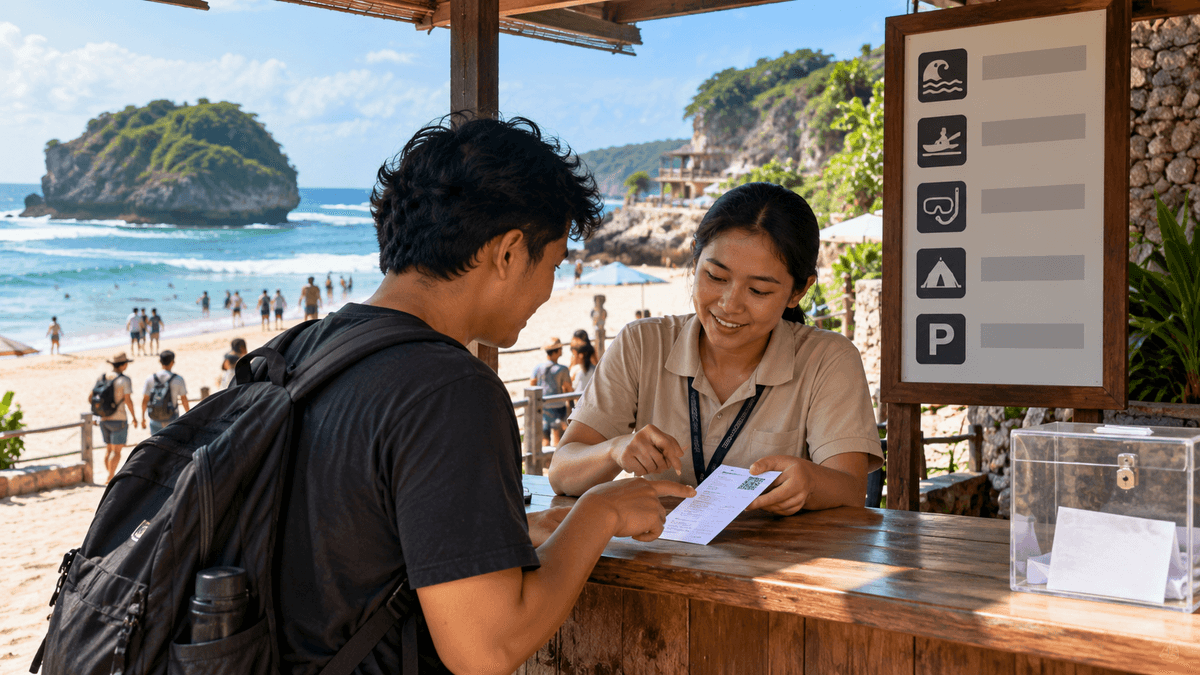
A tourism fee can be a source of public revenue, but it does not automatically pay for conservation. The connection depends on the applicable law, how the revenue is recorded and allocated, how budgets are approved, who implements the work, and whether outcomes are publicly reported.
For Gunungkidul, the question is whether existing public revenue and any proposed additional contribution are sufficient, lawfully assigned, transparently managed, and demonstrably connected to the services or environmental needs they are intended to support.
Start with the legal and fiscal distinction
Gunungkidul’s Regional Regulation No. 9 of 2023 governs local taxes and retributions. The national legal database records it as in force and describes its scope as covering taxes, retributions, collection procedures, taxpayer-data confidentiality, guidance, and supervision. Official regulation record (opens in a new tab).
Regent Regulation No. 55 of 2024 concerns the assignment of collection of recreation, tourism, and sports-service retributions to kalurahan governments (village-level governments in Yogyakarta’s administrative system). Its published summary includes collection, deposit procedures, distribution of entrance-retribution proceeds, disbursement and use, guidance, and supervision. Official regulation record (opens in a new tab).
These regulations establish that tourism retribution and its administration are matters of formal public governance. They do not, by themselves, justify a claim that all tourism revenue is earmarked for conservation, or that a new conservation charge can be created informally. The exact tariff, collection authority, distribution, permitted use, and reporting requirements must be checked against the full applicable legal texts and current budget rules. This article therefore does not assign a percentage of current entrance fees to conservation.
Revenue and environmental outcomes are separate
A government may collect a substantial amount from tourism while spending it on several lawful public purposes. Conversely, a small amount of targeted funding can be effective when it addresses a clearly defined need, such as waste collection, trail maintenance, habitat restoration, water monitoring, or public safety. The amount alone does not show whether the environmental problem is improving.
A conservation-finance system needs a chain of evidence:
- Defined need. State the problem by place and service: for example, litter removal, reef or habitat management where applicable, restoration, erosion control, wastewater risks, visitor safety, or monitoring.
- Legal revenue instrument. Identify whether the funding would come through an existing retribution, general revenue, a lawful budget allocation, a grant, a donation, a business contribution, or another authorized mechanism. These instruments are not interchangeable.
- Allocation decision. Show how funding is included in the appropriate budget or financial arrangement and which institution has spending authority.
- Delivery and procurement. Identify who will carry out the work, what will be delivered, how quality is checked, and how conflicts of interest are managed.
- Outcome measurement. Publish a baseline and repeat measurement. Count waste collected only when that is the relevant output; also track whether litter, pollution, damage, or service failures decline.
- Public accounting. Report receipts, allocations, expenditures, implementing units, outputs, and outcomes in a format the public can understand.
The Ministry or agency responsible for conservation and the local government may use different funding channels for different needs. A tourism operator may also have separate obligations under permits or environmental approvals. General public revenue should not be presented as a substitute for a legally responsible operator’s duty to prevent or address harm.
Earmarking is a policy choice that needs legal review
The idea of dedicating a share of tourism revenue to a destination can be attractive because visitors see a direct relationship between their payment and the place they use. Yet the legal form matters. Public revenue collection and expenditure must follow the relevant rules. Before promising that each ticket directly funds a particular beach, the government must confirm whether the proposed allocation is permitted and how it will be authorized, budgeted, transferred, and audited.
A transparent alternative, where direct earmarking is not legally available or suitable, is to publish an annual “tourism and destination services” account. It can show revenue collected, amounts transferred through the legal revenue-sharing system, relevant budget appropriations, conservation-related spending, and measured work delivered. Policy choices and aggregate public spending become clearer, even though not every rupiah of revenue is technically traceable to one specific visitor.
Gunungkidul’s Tourism Office explained in February 2026 that Regional Regulation No. 9 of 2023 serves as a legal basis for local tax and retribution collection, and described current payment arrangements. Its explanation is useful as an official statement of implementation, while the regulation itself remains the primary legal source. Tourism Office explanation (opens in a new tab).
What should conservation spending buy?
A budget line labeled “environment” is too broad to assess. A destination-specific plan should connect each expense to a defined need and measurable output. For example:
- Waste: collection coverage, disposal destination, frequency, illegal-dumping incidents, and the condition of collection points.
- Water and wastewater: water quality, treatment performance, maintenance, monitoring frequency, and corrective action after noncompliance.
- Habitat or landscape restoration: area treated, methods used, survival or recovery indicators, and maintenance after planting or construction.
- Visitor management: safety equipment, signs, enforcement, access control where justified, and incidents or violations over time.
- Public information: accessible condition reports, visitor guidance, monitoring data, and documented response to complaints.
The appropriate indicators will differ by site. A beach, karst cave, village attraction, and inland recreation area have different ecological processes and service needs. A uniform spending formula based only on visitor numbers may ignore those differences.
Make the distribution of costs fair
Tourism charges can affect visitor demand and the affordability of trips, particularly for price-sensitive domestic households. An increase may be justified if costs have risen or services need funding, but the decision should be based on clear legal authority, cost evidence, public service needs, and the likely distribution of the burden.
There are also differences among who benefits. Local households may receive income from tourism, while other residents use roads, water, coastal areas, or public facilities without earning directly from visitors. Businesses may gain from public access and environmental quality, but smaller operators have less capacity to absorb unexpected fees. Conservation finance should not be designed as though all residents, businesses, and visitors have the same income or benefit.
Potential safeguards include transparent notice of the charge and its purpose, consistent collection with proof of payment, accessible complaint channels, periodic review, and exemptions or reductions only where authorized by law. Additional fees should not be introduced by informal collection arrangements or described as mandatory public levies without a verified legal basis.
Use the polluter-pays principle carefully
The broader policy principle that polluters should bear the costs of pollution prevention or remediation can help assign responsibility. It does not mean that any tourism business can be charged a conservation fee without evidence, authority, or due process. Responsibility for a specific incident depends on facts, applicable legal duties, and the decisions of competent authorities.
The same caution applies in the other direction: public conservation spending should not conceal private obligations. Where a development creates a specific, attributable impact or has enforceable mitigation and restoration conditions, the responsible party’s duties must be handled through the relevant legal process. A general tourism-revenue program should complement public management, not replace compliance and enforcement.
An annual destination-finance statement
Gunungkidul could improve accountability by publishing a concise annual statement for major tourism areas. Depending on legal and accounting arrangements, it could include: retribution collected; distribution and transfer details; relevant public-budget allocations; funding from grants or other authorized sources; spending by service category; contracts and implementing agencies; output measures; and environmental indicators.
The report should clarify what it cannot show. If revenue is pooled in the general budget, the government should not pretend that an individual ticket can be traced directly to an individual conservation task. It can still disclose which allocations were approved and what services were delivered. If a particular outcome cannot be measured yet, the next step is to establish a baseline rather than declare success.
A fee is only as credible as the service and accounting behind it
Tourism revenue can help sustain a destination, but higher collection is not the same as better conservation. Gunungkidul should link any proposed use of tourism fees to a defined environmental or public-service need, a lawful financing route, an accountable implementing institution, and indicators that can be checked over time.
The policy test is straightforward: can residents and visitors see what was collected, how decisions were made, what was paid for, and whether the condition of the destination improved? That is more convincing than a generic promise that tourism revenue supports sustainability.
Sources consulted
- BPK RI, Database Peraturan. “Perda Kabupaten Gunungkidul Nomor 9 Tahun 2023 tentang Pajak Daerah dan Retribusi Daerah (opens in a new tab).” Published/dated: 21 December 2023. Accessed: 25 October 2026.
- BPK RI, Database Peraturan. “Perbup Kabupaten Gunungkidul Nomor 55 Tahun 2024 tentang Penugasan Pemungutan Retribusi Pelayanan Tempat Rekreasi, Pariwisata dan Olahraga kepada Pemerintah Kalurahan (opens in a new tab).” Published/dated: 31 December 2024. Accessed: 25 October 2026.
- Dinas Pariwisata, Ekonomi Kreatif, Pemuda, dan Olahraga Kabupaten Gunungkidul. “Sudah Tahu kah Kamu Tentang Perda No.9 Tahun 2023? (opens in a new tab).” Published/dated: 25 February 2026. Accessed: 25 October 2026.
- BPK RI, Database Peraturan. “Perda Kabupaten Gunungkidul Nomor 1 Tahun 2025 tentang Rencana Perlindungan dan Pengelolaan Lingkungan Hidup Kabupaten Gunungkidul Tahun 2025-2055 (opens in a new tab).” Published/dated: 15 July 2025. Accessed: 25 October 2026.
- BPK RI, Database Peraturan. “Peraturan Pemerintah Nomor 22 Tahun 2021 tentang Penyelenggaraan Perlindungan dan Pengelolaan Lingkungan Hidup (opens in a new tab).” Published/dated: 2 February 2021. Accessed: 25 October 2026.
Keep reading
This article is part 4 of 11 in the series "Investment, Policy and the Next Decade".
- Previous: Tourism Infrastructure: Who Pays, Who Uses It, and Who Benefits?
- Start of the series: Tourism Investment Must Deliver More Than a Headline Figure
Related articles: