Tourism Infrastructure: Who Pays, Who Uses It, and Who Benefits?
Roads, water, sanitation, drainage, and waste systems can support tourism and everyday life. Gunungkidul needs to account for construction, maintenance, environmental pressure, and the distribution of benefits.
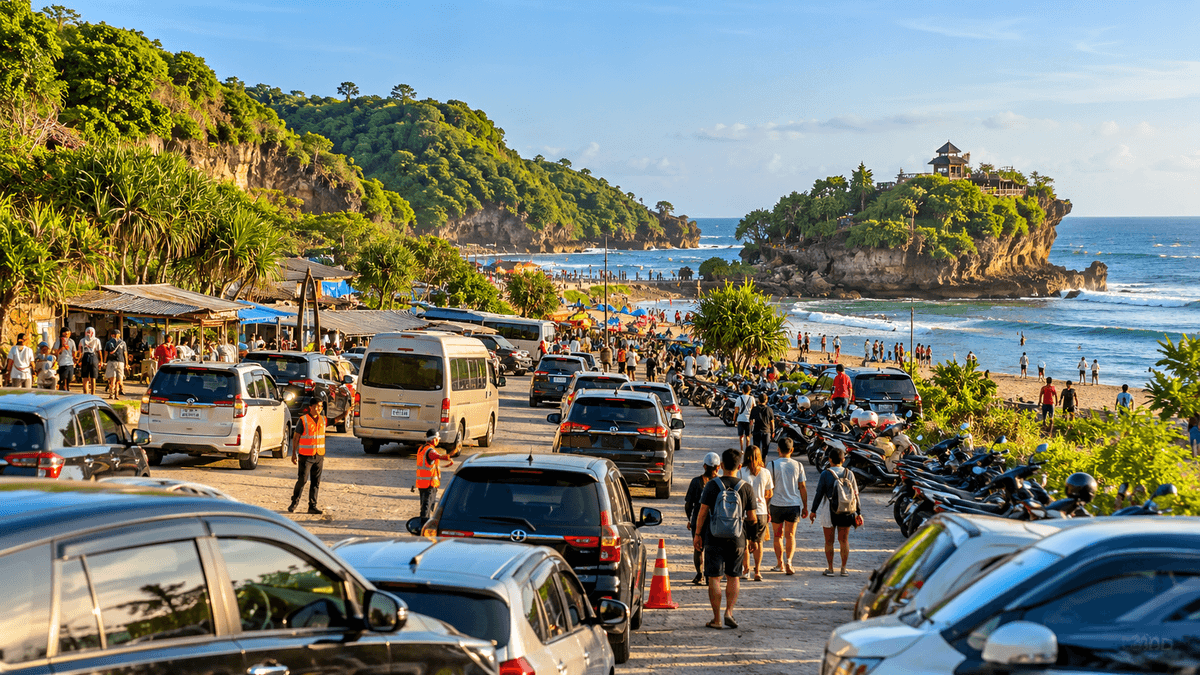
A tourism project may be privately owned while depending on infrastructure paid for, maintained, or regulated by the public. Roads, drainage, water supply, sanitation, waste collection, emergency response, and public-space management often serve visitors and residents at the same time. The policy challenge is to identify who benefits, who bears which cost, and who is responsible for operation and maintenance over the asset’s full life, whether the infrastructure is public or private.
Costs continue after construction
Project announcements tend to foreground capital expenditure: a road upgraded, a water system built, a parking area added, or a public facility renovated. Yet infrastructure also creates recurring costs. Drains must be cleared, roads repaired, waste collected, sanitation systems operated, water sources managed, and emergency facilities staffed or maintained.
A tourism area can be left with an asset that is impressive on opening day but costly to operate. If the operating budget does not match the service needs, the consequences may appear as overflowing bins, broken access roads, unreliable water, untreated wastewater, or a burden shifted to households and local government. These are risks to assess rather than claims that every tourism area in Gunungkidul currently experiences all of them.
A sound appraisal therefore distinguishes at least four cost layers:
- Capital cost: land acquisition where applicable, design, construction, equipment, and the cost of financing.
- Operating cost: electricity, staffing, supplies, pumping, treatment, collection, security, and routine service delivery.
- Maintenance and renewal: repairs, periodic replacement, rehabilitation, and resilience upgrades.
- Environmental and social cost: resource pressure, pollution risk, habitat disturbance, congestion, safety demands, or restrictions imposed on existing users.
Not all these costs should automatically be assigned to a tourism operator. Some assets serve a broader public purpose. But they should be visible when government compares project alternatives or decides whether public spending is justified.
Public infrastructure can create more than one kind of benefit
A road may serve a tourism business, a village school, agricultural producers, emergency services, and residents commuting to work. A water network may reduce household hardship while also supporting hotels and restaurants. Waste collection improves the visitor experience and public health. These shared benefits matter when deciding how an asset should be funded.
The reverse is also true: a project may create demand that requires extra capacity. If a new complex materially increases vehicle movements, water demand, wastewater volume, or peak-day waste, the assessment should establish what additional capacity is needed and who is legally and financially responsible for it. A public contribution may still be reasonable, but it should be based on public value and a transparent financing decision rather than on a vague promise that investment will eventually benefit everyone.
Gunungkidul’s RPPLH for 2025-2055 provides a long-term environmental planning framework that addresses conditions and indications of environmental carrying capacity, problems, targets, and management directions. Infrastructure and tourism investment should be assessed in a way that is consistent with that framework and the specific rules that apply to each location. Official RPPLH record (opens in a new tab).
Build a service-area account before approving a project
A practical way forward is to prepare a service-area account for each major tourism development or destination cluster. It should answer six questions.
What service will be provided? Define the road, water, sanitation, drainage, waste, safety, or public-space problem. Do not start by assuming that a new structure is the only solution; maintenance, demand management, operational changes, or a smaller intervention may deliver better value.
Who uses it? Estimate demand across user groups and seasons. Visitors, residents, workers, suppliers, and other businesses may have different peaks and needs. Averages can hide pressure during holiday periods.
What capacity is required? State the assumptions, engineering basis, expected utilization, and uncertainty. Where reliable data is missing, use clearly labeled scenarios rather than presenting a single forecast as certain.
Who funds construction? Identify public budgets, developer-funded works, lawful fees, grants, or other financing sources. Clarify ownership and handover conditions.
Who pays for operation and renewal? Name the organization responsible for daily operation, inspections, repairs, and future replacement. Specify an annual funding mechanism and a contingency plan.
How will performance be measured? Use indicators appropriate to the service: water reliability, wastewater-treatment performance, waste collection coverage, drainage incidents, road condition, response time, user access, or service cost per unit. A facility count is not a performance measure by itself.
Investment and infrastructure figures need careful interpretation
DPMPTSP reported total recorded investment of IDR 851.75 billion in Gunungkidul for calendar year 2025, based on OSS and LKPM reporting. That figure covers investment reported across the district, not tourism infrastructure spending alone. It should not be used as a proxy for the amount of money available for roads, water systems, or sanitation, nor as evidence that tourism infrastructure needs have been met. DPMPTSP’s 2025 investment report (opens in a new tab).
A more useful public dataset would show infrastructure spending by asset type, location, funding source, commissioning date, operating agency, maintenance budget, and service outcomes. Where an asset is linked to a specific development, the register should also explain whether it was required for the project, intended for broader public use, or undertaken as part of an existing government service plan.
Choose financing based on public purpose and user benefit
There is no single financing model that fits every asset. A public road with broad community use may reasonably rely on public funds. A dedicated internal access road serving one private site may be more appropriately funded and maintained by the operator, subject to law and the actual agreement. Water and waste facilities may require a mixed model, provided the contributions and service obligations are transparent and legal.
Public-private partnership structures can be useful for some large assets, but they do not eliminate risk. Government must understand demand forecasts, payment commitments, contract duration, performance standards, termination conditions, and the consequences if the operator fails. A project should not be called “private financing” if the public ultimately carries poorly disclosed guarantees or long-term payments.
Likewise, a contribution from a tourism business should not be treated as a substitute for the permits, service charges, environmental obligations, or other legal requirements that apply to it. Any development agreement must be reviewed against the relevant procurement, budgeting, licensing, and public-finance rules.
Measure whether residents share the benefit
Infrastructure can be economically valuable without generating a direct profit. The evaluation should therefore identify who gains time, reliability, safety, access, or health benefits. At the same time, it should show who experiences construction disruption, higher demand on local resources, access restrictions, or additional maintenance burdens.
The distributional analysis can be made concrete. Compare service quality before and after the project for nearby households, workers, local suppliers, and visitors. Measure seasonal conditions as well as annual averages. Ask whether residents who do not directly earn tourism income can still access the improved road, public space, or service. When access is restricted, document the legal basis and the reasons.
A fair infrastructure plan also includes consultation and complaint resolution. Residents should be able to report broken facilities, waste problems, flooding, unsafe access, or unequal service. Government and operators should publish who is responsible for responding and within what general process, rather than letting complaints circulate without clear ownership.
Infrastructure is a long-term service
For Gunungkidul, the central test is whether infrastructure provides dependable services at a reasonable lifecycle cost and whether its benefits are fairly shared. New construction may be necessary, but sometimes maintenance, better scheduling, stronger collection systems, or coordinated management will deliver more value than another physical project.
Before approving a major tourism-related investment, publish a simple service-area account: demand, capacity, funding, maintenance, responsibilities, risk, and performance indicators. Review it after the project opens, using actual use and operating costs. That is how the district can distinguish infrastructure that supports durable local prosperity from infrastructure whose visible capital cost is easier to celebrate than its long-term obligations.
Sources consulted
- BPK RI, Database Peraturan. “Perda Kabupaten Gunungkidul Nomor 1 Tahun 2025 tentang Rencana Perlindungan dan Pengelolaan Lingkungan Hidup Kabupaten Gunungkidul Tahun 2025-2055 (opens in a new tab).” Published/dated: 15 July 2025. Accessed: 25 October 2026.
- DPMPTSP Kabupaten Gunungkidul. “Capaian Realisasi Investasi Kabupaten Gunungkidul Tahun 2025 Melebihi Target yang Ditetapkan (opens in a new tab).” Published/dated: 15 January 2026. Accessed: 25 October 2026.
- BPK RI, Database Peraturan. “Peraturan Pemerintah Nomor 22 Tahun 2021 tentang Penyelenggaraan Perlindungan dan Pengelolaan Lingkungan Hidup (opens in a new tab).” Published/dated: 2 February 2021. Accessed: 25 October 2026.
- BPK RI, Database Peraturan. “Peraturan Pemerintah Nomor 28 Tahun 2025 tentang Penyelenggaraan Perizinan Berusaha Berbasis Risiko (opens in a new tab).” Published/dated: 5 June 2025. Accessed: 25 October 2026.
- BPK RI, Database Peraturan. “Perbup Kabupaten Gunungkidul Nomor 50 Tahun 2024 tentang Rencana Detail Tata Ruang Wilayah Perencanaan Pantai Selatan Bagian Timur Tahun 2024-2044 (opens in a new tab).” Published/dated: 27 December 2024. Accessed: 25 October 2026.
Keep reading
This article is part 3 of 11 in the series "Investment, Policy and the Next Decade".
- Previous: Investors Need Clear Rules, and Communities Need Environmental Certainty
- Start of the series: Tourism Investment Must Deliver More Than a Headline Figure
Related articles: