Water Is Tourism Infrastructure in Gunungkidul
Tourism depends on water for guests, workers, food service, sanitation, and landscapes. In a karst region with uneven seasonal access, destination planning must measure water security rather than assume supply is unlimited.
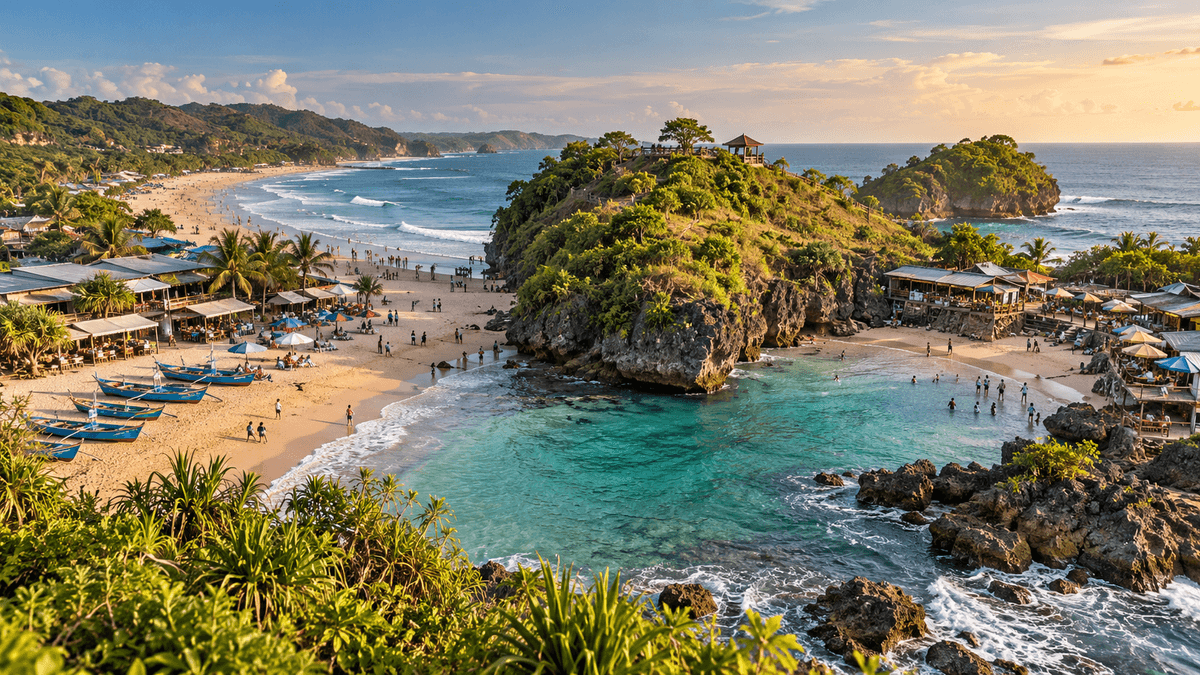
A tourism destination can be busy and still be water-insecure
Water is easy to overlook when tourism is discussed through visitor counts, new attractions, hotel rooms, and road access. Yet every overnight stay, restaurant meal, public toilet, laundry load, and landscaped area adds some level of water demand. If a destination's water supply is seasonal, difficult to distribute, or poorly measured, growth can create pressure even when the wider region contains substantial groundwater resources.
Gunungkidul's karst setting makes this question particularly important, but it would be inaccurate to say every village has the same water problem. Local geology, access to springs or underground sources, infrastructure, elevation, household storage, rainfall, and the reach of piped systems can create very different conditions from one location to another.
A useful water policy therefore starts with a local question: where does the water serving a particular destination come from, how reliable is that supply across the year, and what happens to household access when demand rises?
Karst water behaves as a system
Karst develops as water dissolves carbonate rock, creating pathways at the surface and underground. Water may enter through fractures, sinkholes, and other openings and travel through a complex network of fissures, conduits, caves, and underground rivers. This can create significant groundwater resources, but it can also make flow and quality difficult to predict without site-specific investigation.
A 2025 study of drought vulnerability in Giricahyo Village, Purwosari, used a geographic information system to combine rainfall, soil, slope, geology, and land-use variables. It identified several vulnerability classes, with the high-vulnerability class concentrated in steep areas with porous Lithosol soils. The authors reported only 42.5% consistency between the model and field validation; differences were associated in part with piped-water infrastructure. That limitation is important: a vulnerability map can guide investigation, but it is not a substitute for verified supply, service, and household-access data. See the study in Jurnal Geografi (opens in a new tab).
In practical terms, the amount of water that may exist within a regional underground system and the reliability of water at a particular property are different questions. A source can exist underground while extraction, pumping energy, pipeline infrastructure, water quality, maintenance, or seasonal flow limits its usable supply. A regional estimate should therefore be paired with local monitoring and service data before it is used to justify a new tourism demand.
The public response shows why access matters
On 22 July 2026, the Audit Board of Indonesia's Yogyakarta representative office reported a change in how clean-water deliveries would be prioritized in Gunungkidul. The report said 12 of the regency's 18 kapanewon (subdistrict-level administrative units) had dedicated budgets for water distribution, and the regency's disaster-management agency had prepared around 1,500 water-tanker loads for affected residents ahead of the forecast dry season. These are reported preparations and administrative arrangements, not proof that the entire allocation was delivered or that every area experienced the same shortage. Read the BPK Yogyakarta report (opens in a new tab).
Public water deliveries are not a direct measure of tourism's effect on household supply. Drought, rainfall patterns, infrastructure, demand from residents, agriculture, and other uses also matter. However, recurring dependence on emergency distribution is a reason for local planners to include water access in destination-growth decisions rather than treating it as a separate issue for disaster response.
Measure water demand before expanding capacity
Tourism proposals are often evaluated through floor area, room count, expected guests, or projected revenue. For water-sensitive locations, a proposal should also provide a defensible demand estimate. The estimate needs to distinguish daily average demand from peak-day demand and identify the actual source and legal or operational conditions of supply.
A basic tourism water budget should include:
- Source and reliability: source type, seasonal flow or yield, permitted abstraction where applicable, quality, and the evidence supporting the estimate.
- Demand: expected guests, staff, food service, laundry, cleaning, public toilets, pools or other water-intensive amenities, and outdoor irrigation.
- Peak conditions: holiday occupancy, simultaneous visitor demand, and the dry-season period when supply may be most constrained.
- Efficiency: metering, leak detection, low-flow fixtures, linen-reuse policies where appropriate, water-efficient cleaning, and reuse systems where safe and lawful.
- Wastewater: the volume and quality of wastewater generated, treatment capacity, maintenance responsibility, and the discharge or reuse route.
- Community access: whether the proposed demand shares infrastructure or sources with households and whether safeguards are in place during shortages.
Where exact coefficients for water use per guest are not available for the project, the right response is to measure or estimate transparently using disclosed assumptions, not to insert a generic figure and present it as local fact.
Avoid two opposite mistakes
The first mistake is to assume the region has enough groundwater, so tourism can expand without further analysis. Regional groundwater potential does not guarantee safe, accessible, sustainable supply to every site.
The second mistake is to assume that a karst area should never host tourism because some communities experience drought. That conclusion also skips necessary evidence. Water access varies geographically, and interventions such as rainwater harvesting, storage, improved distribution, leak control, suitable treatment, and carefully assessed groundwater use may alter local conditions. Whether a development is appropriate depends on its location, source, demand, environmental effects, alternatives, and effect on existing users.
The fair standard allows tourism demand but prevents it from being authorized on an unsupported assumption that another user will absorb the shortfall.
A water-security standard for tourism
Gunungkidul's Regional Environmental Protection and Management Plan for 2025-2055, established by Regional Regulation No. 1 of 2025 (opens in a new tab), provides the formal long-term planning framework for environmental carrying capacity, environmental quality, and resource management. To make that framework meaningful for tourism, site-level implementation should connect planning with measurable indicators.
Public authorities can require water budgets and seasonal-risk assessments where relevant, prioritize monitoring in vulnerable catchments, and publish aggregate information on supply reliability. Destination operators can meter actual consumption per occupied room or visitor, document source arrangements, and disclose the system used to handle wastewater. Local water providers and community representatives should have a role in identifying where new demand may conflict with household needs.
A useful annual scorecard would compare source reliability, dry-season interruption days, water consumption per visitor or occupied room, leakage rates, wastewater compliance, and household-service indicators. The exact set should match the site's system and data availability. Reporting a single annual total is not enough to reveal a shortage that occurs only during the peak dry season.
The bottom line
Water is core tourism infrastructure, just like access roads and sanitation. Gunungkidul's karst aquifers can offer important water resources, but availability, quality, distribution, and seasonal reliability are not interchangeable. Tourism growth should be assessed against a transparent local water budget, with household access protected and wastewater managed. This is an argument against approving water demand before establishing whether the supply can sustain it, and it places no automatic restriction on development.
Sources consulted
- Government of Gunungkidul. Regional Regulation No. 1 of 2025 on the Regional Environmental Protection and Management Plan for 2025-2055. Enacted 15 July 2025; checked 25 October 2026. https://peraturan.bpk.go.id/Details/330388 (opens in a new tab)
- Hasmaulia, Q. “Analisis Rawan Kekeringan di Desa Giricahyo, Kecamatan Purwosari, Gunung Kidul” [Drought Vulnerability Analysis in Giricahyo Village]. Jurnal Geografi, Vol. 21, No. 2, published 22 December 2025; checked 25 October 2026. https://ejurnal.undana.ac.id/index.php/jgeo/article/view/22814 (opens in a new tab)
- Audit Board of the Republic of Indonesia, Yogyakarta Representative Office. “Skema Droping Air di Gunungkidul Berubah, Kapanewon Jadi Prioritas” [Gunungkidul Water-Delivery Scheme Changes, Prioritizing Subdistricts]. Published 22 July 2026; checked 25 October 2026. https://yogyakarta.bpk.go.id/skema-droping-air-di-gunungkidul-berubah-kapanewon-jadi-prioritas/ (opens in a new tab)
Keep reading
This article is part 2 of 12 in the series "Conservation, Environment and the Tourism Trade-off".
- Previous: Gunung Sewu Karst: The Ecological Foundation of Tourism
- Start of the series: Gunung Sewu Karst: The Ecological Foundation of Tourism