Pantai Ngobaran: Tourism Revenue, Cultural Respect, and Community Control
Tourism around culturally significant places raises questions about visitor access, interpretation, photography, consent, and local authority. Ngobaran's documented cultural context provides a starting point, but current rules and community perspectives must be confirmed before they are represented as agreed practice.
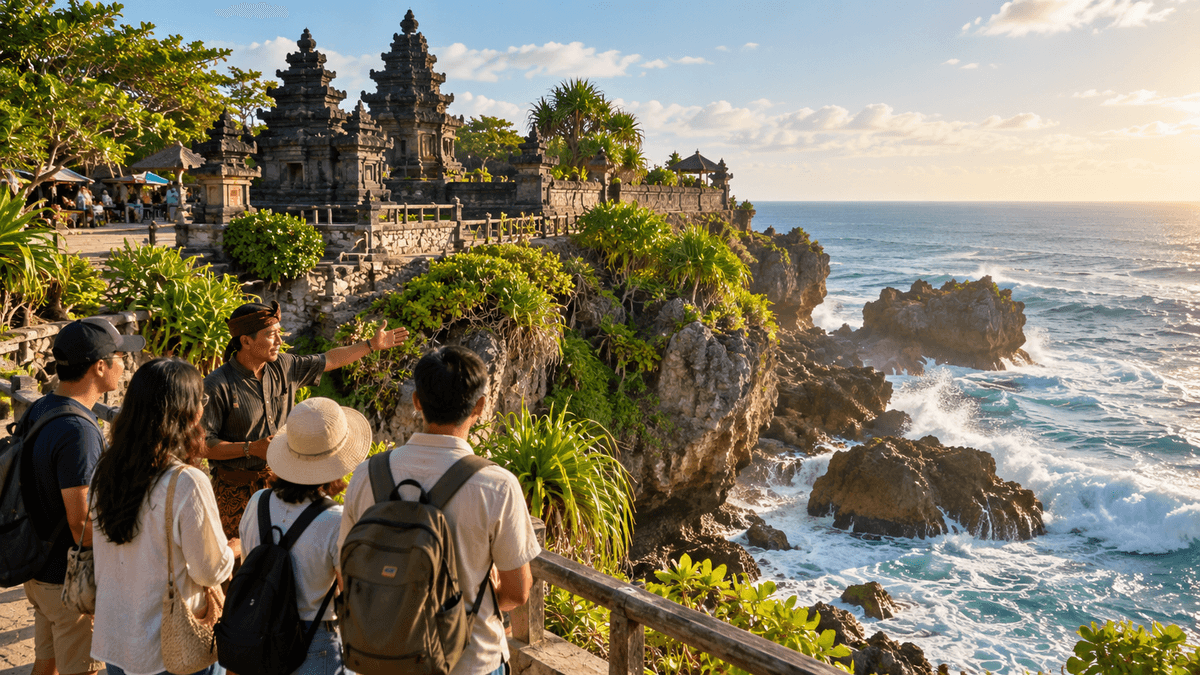
Revenue is one question at a culturally significant place
Tourism can create opportunities for food sellers, guides, transport providers, and other local businesses. At a place associated with religious or spiritual practice, however, commercial opportunity must not be treated as permission to turn every practice, building, image, or ritual space into a visitor product. The central governance question is who has the authority to explain, manage, restrict, or invite tourism activity, and how that authority is respected when visitors and businesses seek access.
Pantai Ngobaran is a useful case for examining that question, but the available public material does not provide a current account of local rules, custodians' preferences, consent arrangements, visitor conduct, or how tourism revenue is distributed. This article therefore distinguishes what the destination's official tourism profile has described from what remains to be confirmed. It proposes a governance framework; it does not claim to speak for Ngobaran's religious practitioners or residents.
What the public record says and leaves unsaid
The Gunungkidul tourism portal's profile of Pantai Ngobaran, published in July 2020 and updated in October 2022, describes religious ceremonies and rituals associated with Hindu and Kejawen practices and notes the presence of a Hindu place of worship on a cliff. That is an official description of the destination's cultural framing at the time of the page's update. It does not establish the current ritual calendar, rules for entering particular spaces, accepted forms of photography, the identity of all relevant custodians, or the views of different local groups. (Gunungkidul Tourism Office, “Pantai Ngobaran,” published July 15, 2020; updated October 13, 2022 (opens in a new tab)).
The distinction is important. A destination profile is not a community consultation record. It may describe a place for a general audience without explaining which activities require permission or which spaces have distinct meanings for different practitioners. Nor does the existence of a tourism listing establish that every religious or cultural practice is publicly accessible or available for commercial promotion.
The UN Tourism Global Code of Ethics for Tourism provides normative guidance on respecting host communities' cultural and religious traditions and on ensuring that visits to religious buildings do not prejudice normal worship. The code is not a substitute for Indonesian law, a site-specific rule, or local consent. Its relevance here is as a general ethical reference: visitor access and tourism revenue should not override the practices and needs of the people who use a place. (UN Tourism, “Global Code of Ethics for Tourism,” adopted 1999; current resource page checked October 26, 2026 (opens in a new tab)).
The sources consulted do not establish whether Ngobaran currently prohibits a particular activity, operates a formal consent protocol, or has an agreed revenue-sharing mechanism. Visitors, businesses, and media producers should not infer such rules or agreements from the destination listing alone. Where an activity depends on local access, worship, or cultural practice, they should seek current guidance from the relevant custodian or responsible authority.
Distinguish different kinds of authority
Cultural-site governance often involves more than one legitimate role. The relevant public agency may manage tourism information, facilities, or public access. Land managers or legally authorized authorities may control specific areas. Religious or cultural custodians may have responsibility for practices, interpretation, and customary conduct. Residents and businesses may be affected by traffic, visitor behavior, access arrangements, or changes in economic opportunity. These roles can overlap, but they should not be assumed to be interchangeable.
For Ngobaran, the first step is to identify which authority applies to which decision. Who can confirm the rules for a specific worship space? Who is authorized to provide interpretation? Who can approve photography or filming during a ceremony? Who manages a visitor complaint? Which decisions belong to public agencies, and which require consent from practitioners or custodians? These are questions for consultation, not answers that can be inferred from a tourist brochure.
It is also important not to treat “the community” as one uniform voice. People may have different interests based on their responsibilities, religious practice, livelihood, land access, or relationship to tourism. A consultation process should identify relevant participants without assuming that a single business owner, official, or spokesperson can represent every affected group. Any account of their views should be attributed to the people who expressed them and should not be generalized beyond the evidence.
Cultural respect must be made operational
Broad statements about respect are not sufficient for day-to-day management. If local custodians and relevant authorities choose to establish or update visitor guidance, it should answer specific questions in language visitors can understand. The following are proposed topics for review, not a statement that these rules are already in force at Ngobaran.
Access and the use of space
Guidance can distinguish areas open for ordinary sightseeing from spaces used for worship or practices that require additional care. Any boundaries, closures, or restricted periods should be confirmed by the responsible authority and explained before visitors reach the relevant space. A tourism operator should not create its own access promises where another party has authority over the area.
Photography, recording, and representation
A public view of a building or landscape does not automatically imply consent to record identifiable people, private ceremonies, or sacred practices. Site guidance should be developed with the relevant custodians and should distinguish general landscape photography from images or recordings of ceremonies and participants. Where permission is required, visitors and commercial content producers should be told who can grant it and how to ask. These recommendations should not be published as existing Ngobaran rules until locally confirmed.
Conduct and interpretation
Visitor information can explain respectful conduct, appropriate clothing where applicable, noise, litter, and the difference between a public attraction and a place used for worship. Interpretive material should be reviewed by people qualified to explain the traditions being described. Simplifying different beliefs into a single story for promotion risks misrepresenting the people and practices involved.
Commercial products and promotions
Businesses may sell food, transport, souvenirs, or guiding services, subject to applicable rules. A separate decision is whether a ceremony, symbol, image, or cultural narrative may be used to market a product. That question requires more than a commercial opportunity: it requires confirmation of who has authority, whether consent is needed, how the depiction will be used, and whether there are conditions on payment, attribution, or reuse. The article does not offer legal advice or assert that one intellectual-property arrangement applies to all cultural practices.
Revenue and accountability without inventing local arrangements
A destination can have tourism sales without having reliable evidence about who benefits from them. To understand local value at Ngobaran, data would need to distinguish public retribution or other official charges from private prices for food, transport, retail, guiding, or other services. It would also need to identify who receives the payment, local ownership and employment under a defined geographic boundary, recurring costs, and any agreed payments for the use of cultural material or space.
The public profile reviewed for this article does not provide these figures. No verified site-level dataset was found showing how tourism receipts are distributed among local businesses, workers, public bodies, or cultural custodians. It would therefore be misleading to assert that tourism revenue currently reaches one group more than another, or that a particular revenue-sharing model already exists.
A proportionate first step would be a jointly designed inventory of public services and private offers, alongside a consultation process that identifies what information local stakeholders consider appropriate to collect or publish. Financial data should be aggregated where possible, personal information minimized, and commercial confidentiality respected. Any proposed fee or payment linked to cultural access must be confirmed by the parties with authority and assessed under the applicable legal framework; this article does not assume such a fee should exist.
Transparency also requires separating different kinds of money. Official charges should be identified and explained through authorized channels. Private service prices should be displayed by the relevant business, with clear information on what is included. If a community or cultural organization participates in a tourism arrangement, its role and any agreed payments should be documented transparently and with consent. These are governance principles for consideration, not descriptions of current arrangements at Ngobaran.
A practical consultation and review process
A credible management process should begin with people and responsibilities, not with promotional copy. The following sequence can guide a future review:
- Map the decision-makers and affected groups. Identify the public authority, land or facility manager, relevant cultural and religious custodians, residents, and businesses affected by visitor activity. Verify each role and avoid assigning authority based only on assumptions.
- Ask what can be shared. Consult custodians about how the place and its traditions should be described, which terminology is appropriate, and what images or information are acceptable for public use. Record dissent or different views rather than forcing artificial consensus.
- Confirm applicable rules. Have the responsible public authority confirm rules for access, safety, land, facilities, and business activity. Have the appropriate custodians confirm practices and requests relating to religious or cultural use. One source of authority should not be used to invent the other's rules.
- Create visitor guidance only after review. Use plain language, visible signs, staff briefings, and digital information. Explain any restrictions before visitors arrive, and ensure the guidance can be updated when practice changes.
- Set a complaint and correction route. Visitors and local stakeholders should be able to report misrepresentation, disrespectful conduct, access problems, or inaccurate information. Identify the responsible contact and a process for reviewing complaints without publishing private complainant details.
- Review effects on livelihoods and the site. Monitor visitor problems, business opportunities, maintenance pressure, and any effects on cultural practices. Use the findings to modify guidance or visitor products rather than assuming that every increase in visitation is beneficial.
Consultation should be an ongoing process rather than a single approval used indefinitely. Cultural practices, site management, and visitor patterns can change. A date should be attached to guidance, and material corrections should be made when the relevant people identify an error.
Keep cultural governance distinct from event promotion and intellectual property
Ngobaran may appear in public descriptions of rituals or religious activity, but this article is not an event-economics study. That would require a specific event, budget, vendor contracts, public costs, and evidence on who receives event spending. Nor is this a general legal article about cultural intellectual property. That subject requires its own analysis of applicable law, different rights-holders, licenses, and permitted uses of cultural and creative works.
The narrower issue here is everyday site governance: who can authorize access or interpretation, how visitors are informed, and how commercial activity can be kept from overriding worship or cultural practice. This makes the article distinct from a general community-based tourism framework. The recommendations are deliberately conditional because the current site-level perspective has not been obtained.
Conclusion: Confirm authority before claiming community consent
The official tourism profile describes Ngobaran as a place associated with Hindu and Kejawen practices, but the public record reviewed here does not provide a current account of governance arrangements, custodians' preferences, access protocols, or revenue distribution. The Global Code of Ethics for Tourism offers a general standard for respecting religious and cultural traditions; it is not a site-specific rulebook. This article therefore does not claim that Ngobaran has adopted any particular consent process, photography restriction, fee arrangement, or governance model.
Tourism can create local economic opportunities, but neither visitor demand nor promotional value establishes permission to represent cultural practices or use cultural spaces commercially. The practical contribution of this article is a public-source-based framework for identifying questions that businesses, public agencies, and visitors should not assume away: who is responsible for a particular decision, what current guidance applies, how cultural descriptions are reviewed, and where concerns can be raised. Where the public record is silent, that silence should be described as an information limit, not converted into a claim that a rule, prohibition, consensus, or agreement exists.
For practical decisions involving a particular ceremony, worship space, photograph, or commercial use, readers should check current guidance with the relevant custodian or responsible authority. This recommendation does not imply that a specific restriction currently exists at Ngobaran; it reflects the limited scope of the public sources reviewed.
Sources consulted
- Gunungkidul Tourism Office. “Pantai Ngobaran.” Published July 15, 2020; updated October 13, 2022. https://wisata.gunungkidulkab.go.id/pantai-ngobaran/ (opens in a new tab) (checked October 26, 2026). Used for the dated official cultural description only; it does not substantiate current rules or community views.
- UN Tourism. “Global Code of Ethics for Tourism.” Adopted in 1999; resource page checked October 26, 2026. https://www.untourism.int/global-code-of-ethics-for-tourism (opens in a new tab). Used as normative guidance on respect for cultural and religious traditions; not treated as site-specific law or proof of local practice.
Keep reading
Related articles: