Investors Need Clear Rules, and Communities Need Environmental Certainty
Reliable tourism investment depends on more than fast permits. Gunungkidul needs transparent spatial checks, risk-based licensing, environmental approvals, monitoring, and predictable enforcement.
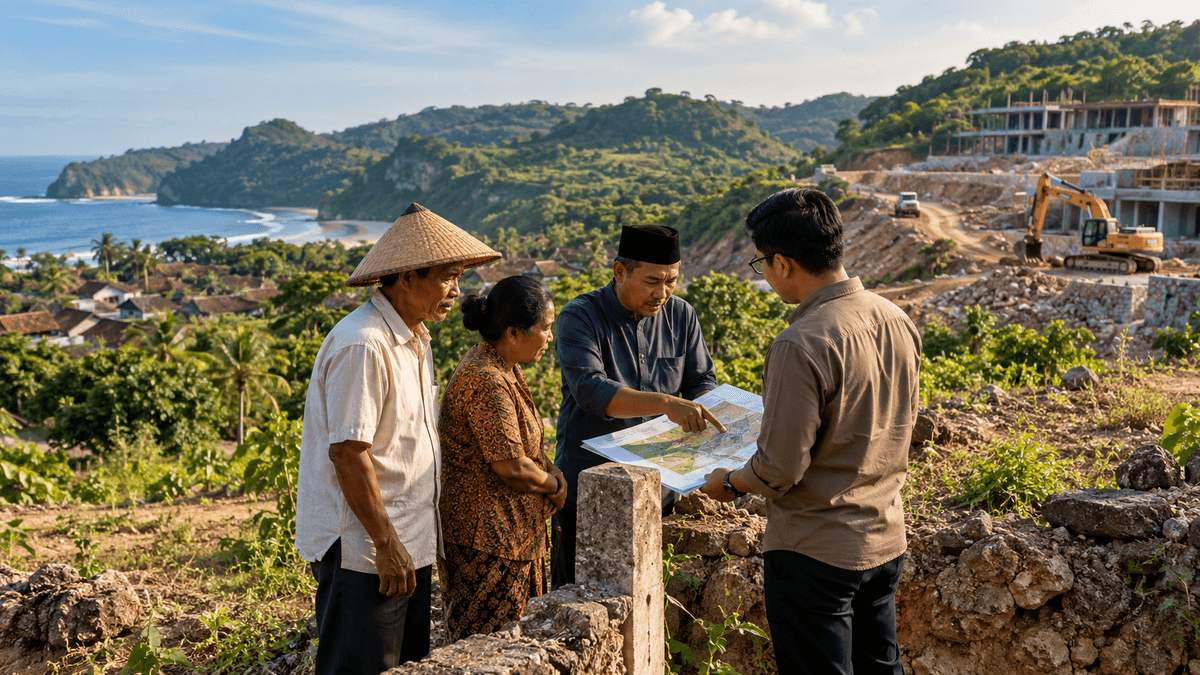
What predictable permitting means
A predictable permit system is good for investment. Predictability here means that the rules, evidence requirements, decision timelines, responsibilities, and consequences are clear before capital is committed. It does not guarantee approval of every proposed project, and it does not relax environmental requirements.
For tourism in Gunungkidul, this distinction matters because projects can depend on sensitive coastlines, karst landscapes, groundwater systems, public access, and infrastructure shared with residents. A fast application process cannot substitute for a sound decision about whether a proposed activity fits its location and can be managed safely.
The rules are layered
Indonesia’s Government Regulation No. 28 of 2025 governs risk-based business licensing and took effect on 5 June 2025, replacing Government Regulation No. 5 of 2021. The regulation covers basic requirements, business licensing, supporting licenses, standards, the Online Single Submission (OSS) system, supervision, evaluation, dispute or barrier handling, and administrative sanctions. The official database identifies it as in force. Official regulatory record (opens in a new tab).
Environmental approval is addressed separately in Government Regulation No. 22 of 2021 on Environmental Protection and Management. Its framework covers environmental approval, water, air and marine quality, pollution and damage control, waste management, monitoring, supervision, and administrative sanctions. A business license and environmental approval therefore answer related but distinct questions: whether the activity has legal authorization to operate, and whether its environmental risks and obligations have been assessed and defined in the way required for that activity. Official regulatory record (opens in a new tab).
Spatial conformity also matters. A project’s proposed location and activity must be checked against the spatial-planning instruments that apply to the specific parcel and location. Gunungkidul has detailed spatial plans for defined planning areas, including the eastern southern-coast planning area under Regent Regulation No. 50 of 2024 and the Siung-Wediombo planning area under Regent Regulation No. 3 of 2021. These are location-specific documents; neither should be treated as a single all-purpose approval for every site in the regency. Pantai Selatan Bagian Timur plan (opens in a new tab); Siung-Wediombo plan (opens in a new tab).
Gunungkidul’s Regional Environmental Protection and Management Plan (RPPLH) for 2025-2055, enacted through Regional Regulation No. 1 of 2025, adds a long-term framework for environmental conditions, carrying capacity, problems, targets, and management direction. It should inform planning and scrutiny, but it does not replace the project-specific approvals that are legally required. Official RPPLH record (opens in a new tab).
Why certainty benefits both investors and residents
Unclear rules impose costs on legitimate investors. They may acquire land, design facilities, sign supply contracts, or borrow money before discovering a land-use conflict or a requirement that changes the project. Residents face a different risk: a development may proceed with an incomplete understanding of its effect on water, access, drainage, waste, landscape, or nearby livelihoods.
A strong system reduces both risks by identifying the applicable requirements early. Before a major tourism investment is marketed as ready, the public-facing project summary should clearly distinguish what is proposed, what land-use checks have been completed, which permits have been issued, which environmental obligations apply, and what approvals remain outstanding. The description must not imply that an investment opportunity is fully permitted merely because it appears in a prospectus or has received investor interest.
A better sequence for project review
A defensible process can be organized into six checks. The responsible agency and exact legal documents vary by project, so this sequence is a practical review framework and does not replace the official licensing pathway.
- Define the activity. Specify what will be built or operated, its scale, operating hours, water demand, waste streams, access needs, visitor capacity, and associated facilities. “Tourism development” is too broad to assess.
- Confirm the site. Establish parcel boundaries, land status, ownership or lawful control, access rights, applicable spatial plan, zoning provisions, and any relevant restrictions. Maps should be checked against authoritative documents rather than promotional renderings alone.
- Determine risk-based licensing and environmental requirements. Use the applicable OSS classification and responsible agencies to establish which basic requirements, business licensing, supporting permits, and environmental approvals are needed. The requirements depend on the activity, scale, site, and current rules.
- Assess cumulative infrastructure and ecological pressure. A project can meet a narrow site-level requirement yet add pressure to a water system, road, coast, or waste service already serving other users. The assessment should consider the relevant receiving environment and cumulative conditions where required and feasible.
- Make conditions operational. Approval documents are useful only if the operator can translate conditions into monitoring, maintenance, emergency procedures, and reporting. Responsibilities must have named owners and budgets.
- Monitor and enforce. Compare actual operation with the approved plans. Define inspection, public complaint routes, corrective actions, and the consequences of noncompliance under the applicable rules.
Environmental approval needs follow-through after construction
A plan, environmental study, or approval is not evidence that all future impacts have been prevented. The central question after construction is whether the project operates according to the conditions, detects problems, corrects them, and reports material results. Government Regulation No. 22 of 2021 expressly includes supervision and enforcement of environmental obligations, including consequences for deviations from the relevant environmental approval and business authorization.
For tourism facilities, monitoring should be selected for the actual risks. Examples may include water consumption and source, wastewater treatment performance, solid-waste volumes and destination, slope or drainage problems, traffic or safety incidents, and restoration outcomes. These are not universal requirements for every business; the official conditions and technical context determine what is required.
Consultation should shape decisions
Local residents may know things that formal project documents cannot fully capture: seasonal access problems, customary use, local water shortages, fishing activity, drainage patterns, or the effects of holiday peaks. Consultation can identify these issues early, but a meeting record alone does not show that concerns were answered.
A credible process records the issue raised, the evidence considered, the responsible agency or developer, the response, any change to the design or management plan, and unresolved matters. Sensitive personal information should be handled carefully, while material public-interest information should be made accessible according to the rules that apply.
The aim is to ensure that decisions are informed, reasons are documented, and people affected by material risks can seek explanations and use the available legal channels. It does not give every participant a veto over every project.
Licensing predictability requires public information
A compact project register could list a project’s activity and location, the status of spatial conformity, relevant licensing stage, environmental approval status where applicable, monitoring obligations, and the public agency responsible for questions. Information should be updated as decisions are issued. Confidential data can be withheld where the law requires it, but secrecy should not become the default for basic project status.
The register should also separate stages precisely: application submitted, application under review, approval issued, construction started, operation started, and monitored operation. This prevents a proposal or permit application from being advertised as a completed, authorized investment.
A fair standard for investment certainty
Investors need timely and consistent decisions; residents need legal protection and evidence that environmental conditions are being observed. These are not contradictory goals. A transparent system can make requirements clearer early, reduce avoidable delays, and provide a basis for enforcement that is fair across operators.
For Gunungkidul, the practical priority is to connect location-specific spatial review, risk-based licensing, environmental approval, infrastructure capacity, and post-approval monitoring. The right question is whether a project’s location, design, obligations, and long-term operating costs are understood before irreversible commitments are made.
The principles above are general. They say nothing about the legal status of any specific parcel or project. Before investment or publication decisions, the current text and applicability of relevant regulations and approvals should be confirmed with the responsible authorities or qualified legal and environmental professionals.
Sources consulted
- BPK RI, Database Peraturan. “Peraturan Pemerintah Nomor 28 Tahun 2025 tentang Penyelenggaraan Perizinan Berusaha Berbasis Risiko (opens in a new tab).” Published/dated: 5 June 2025. Accessed: 25 October 2026.
- BPK RI, Database Peraturan. “Peraturan Pemerintah Nomor 22 Tahun 2021 tentang Penyelenggaraan Perlindungan dan Pengelolaan Lingkungan Hidup (opens in a new tab).” Published/dated: 2 February 2021. Accessed: 25 October 2026.
- BPK RI, Database Peraturan. “Perda Kabupaten Gunungkidul Nomor 1 Tahun 2025 tentang Rencana Perlindungan dan Pengelolaan Lingkungan Hidup Kabupaten Gunungkidul Tahun 2025-2055 (opens in a new tab).” Published/dated: 15 July 2025. Accessed: 25 October 2026.
- BPK RI, Database Peraturan. “Perbup Kabupaten Gunungkidul Nomor 50 Tahun 2024 tentang Rencana Detail Tata Ruang Wilayah Perencanaan Pantai Selatan Bagian Timur Tahun 2024-2044 (opens in a new tab).” Published/dated: 27 December 2024. Accessed: 25 October 2026.
- BPK RI, Database Peraturan. “Perbup Kabupaten Gunungkidul Nomor 3 Tahun 2021 tentang Rencana Detail Tata Ruang Bagian Wilayah Perencanaan Siung-Wediombo Tahun 2020-2040 (opens in a new tab).” Published/dated: 18 January 2021. Accessed: 25 October 2026.
- JDIH Kementerian Keuangan. “Undang-Undang Republik Indonesia Nomor 10 Tahun 2009 tentang Kepariwisataan (opens in a new tab).” Published/dated: 2009. Accessed: 25 October 2026.
Keep reading
This article is part 2 of 11 in the series "Investment, Policy and the Next Decade".
- Previous: Tourism Investment Must Deliver More Than a Headline Figure
- Start of the series: Tourism Investment Must Deliver More Than a Headline Figure