Building Economic Resilience Beyond Holiday Seasons in Gunungkidul
Tourism resilience means more than attracting visitors during peak periods. It requires diversified demand, stronger local supply chains, and livelihoods that can absorb seasonal shocks.
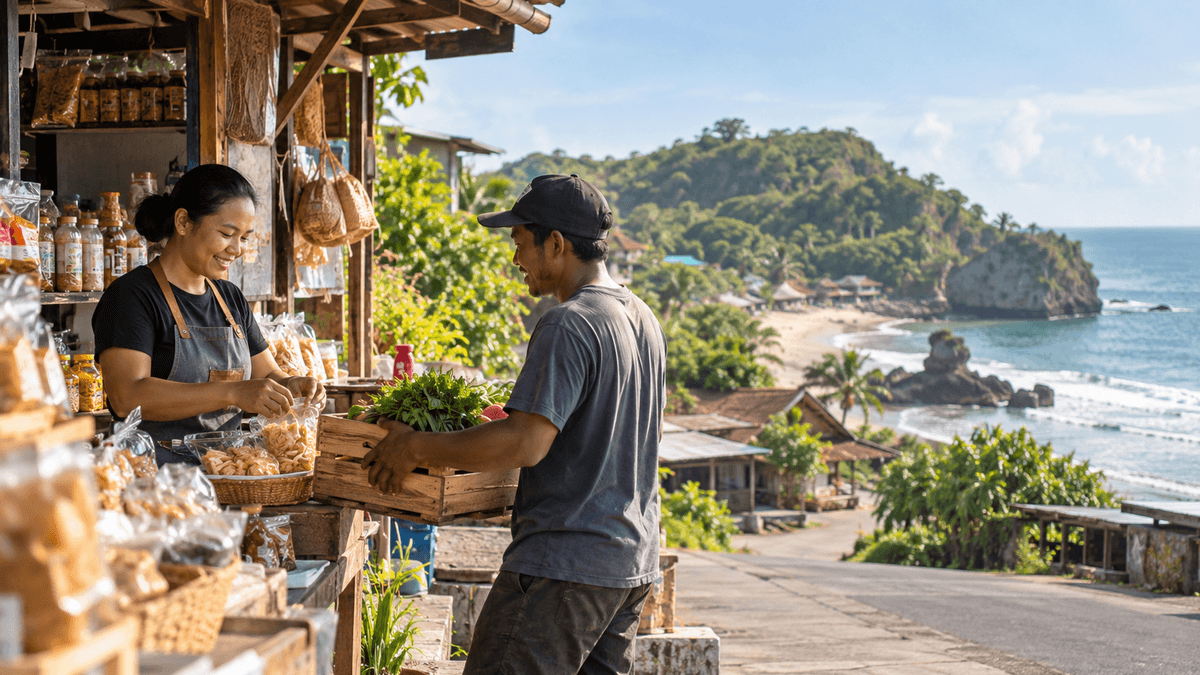
Resilience is the ability to withstand a quiet month
A destination's economic strength shows in how busy it becomes during a long holiday and in what happens when demand falls: whether workers still earn, businesses can cover fixed costs, suppliers continue to sell, and public services remain funded.
Seasonality is not unique to Gunungkidul. Weather, school holidays, religious calendars, transport conditions, event schedules, and household budgets can change when people travel. The policy question is whether local firms and workers have enough flexibility, savings, alternative customers, and year-round products to manage those fluctuations.
Some public data illustrate why monthly analysis matters. Statistics Indonesia's Gunungkidul table for visitors and revenue through the JJLS tourism post recorded 12,733 visits in March 2024 and 75,392 in July 2024. The same series reported IDR 184.6 million and IDR 1.093 billion in revenue for those months, respectively. These figures cover a specific collection point and should not be treated as total visits or revenue for all of Gunungkidul. They do, however, show how pronounced monthly variation can look in a defined channel. BPS Gunungkidul's monthly JJLS table (opens in a new tab).
The right response is to reduce the harm that predictable low-demand periods cause and create a more diverse set of income opportunities, with no need to chase a uniform level of visitor arrivals in every month.
Start with a risk map
A calendar of events can be useful, but it is not a complete resilience plan. Before proposing new events, policymakers should map the types of risk faced by different businesses and households.
A lodging operator may have fixed monthly costs and a high share of revenue concentrated on weekends. A street-food seller may have low fixed costs but depend on foot traffic. A farmer or fisher supplying local restaurants may be exposed to harvest cycles, weather, price shifts, spoilage, and the buying practices of a small number of customers. A worker paid by the day may experience an income shock immediately when visitor demand drops.
A simple survey can ask businesses to report monthly sales bands, main customer segments, regular expenses, number of workers, supplier origin, payment delays, and the share of annual revenue earned during the busiest three months. Workers can be asked about employment continuity, second jobs, debt, and whether their skills are transferable. These data should be aggregated and anonymized before publication.
Four paths to stronger resilience
1. Diversify the visitor offer carefully
A year-round product strategy might combine nature, heritage, food, craft, learning, community activities, and small events. Each product must have a clear audience, operating cost, weather and safety plan, and capacity limit. Adding an event is not automatically good business if its demand is temporary and the cost of staging it exceeds the income retained locally.
Local event calendars and community traditions may give destinations reasons to attract visitors outside a small number of holiday peaks. The official Tourism Office has cited local events, traditions, and community activities as elements in the dynamics of visitor spending during the second quarter of 2026. That is a useful planning prompt, but event-led demand should be measured rather than assumed. Tourism Office spending report, 7 August 2026 (opens in a new tab).
2. Connect tourism to agriculture and fisheries through reliable procurement
The regency's economy is broader than tourism. BPS reported that agriculture, forestry, and fisheries represented 25.32% of Gunungkidul's GRDP in 2025. A local procurement strategy can create links between visitors and producers without requiring every producer to become a tourism operator. BPS's GRDP release (opens in a new tab).
However, “buy local” needs operational design. Farms and fisheries may face uneven volumes, seasonal supply, food safety requirements, cold-chain costs, quality standards, and payment delays. Hotels and restaurants need consistent supply, predictable pricing, and traceability. Possible interventions include producer aggregation, shared storage, simple forward purchasing agreements, quality training, transparent specifications, and faster payment terms.
These arrangements should not push all risks onto small suppliers. If an enterprise requires a particular product volume or quality, the contract should clarify rejection rules, delivery schedules, price adjustments, and who bears spoilage or transport costs. The value of a local supply chain is stronger when repeat transactions are profitable for both sides.
3. Build transferable skills
Training should increase people's options beyond one destination or one employer. Skills in food handling, bookkeeping, digital sales, maintenance, guiding, first aid, transport, hospitality, and quality assurance may support tourism and related sectors. The appropriate course depends on local demand; training should not begin with a list of fashionable skills and search for jobs afterward.
Programs should track completion, placement, wages, contract stability, and whether participants use the skills six or twelve months later. An attendance certificate is an output, not evidence that household resilience improved. Where workers face seasonal income loss, short-term job matching and targeted income support may be needed alongside training. The ILO's just-transition guidance emphasizes social dialogue, decent work, and social protection as parts of managing economic transitions. ILO guidelines (opens in a new tab).
4. Help businesses manage cash-flow risk
Small firms can be vulnerable even when annual revenue appears adequate. The timing of cash inflows may not match rent, electricity, debt, wages, maintenance, and supplier payments. Business-development services can help firms prepare seasonal budgets, build reserves in high-demand months, negotiate supplier terms, adjust operating schedules, and avoid borrowing based on optimistic peak-season assumptions.
Public support should be targeted. Cheap credit alone may worsen risk if a business has no viable market outside the peak season. Support packages should diagnose whether the constraint is demand, product quality, access, working capital, management, infrastructure, or a regulatory requirement.
A resilience scorecard
The regency could publish a compact annual scorecard with monthly breakdowns where the data support them. Possible indicators include:
- Monthly visits and revenue by collection point, clearly labeled by coverage.
- Monthly hotel occupancy and length of stay, with geographic limitations stated.
- The share of surveyed businesses' annual revenue earned in the top three months.
- The share of workers who report paid work in both peak and off-peak periods.
- Local procurement value and the number of repeat supplier relationships.
- Small-business survival, payment delays, and training-to-employment outcomes.
- Waste, water, and service demand during peak and low seasons.
The aim is not to suppress peak demand or promise the same level of activity every month. Some seasonal patterns are natural and efficient. The aim is to know which groups are exposed, which changes are feasible, and whether public interventions are making a measurable difference.
Resilience differs from endless growth
More events and more visitors can also increase congestion, waste, water demand, and pressure on sensitive sites. An all-year promotion campaign may simply spread environmental pressure across more months. Any effort to extend the season should be checked against local carrying capacity, public service readiness, worker conditions, and the net value retained by local firms.
Some areas may benefit from more visitors during quieter months; others may need recovery periods, ecological limits, or maintenance windows. The correct strategy depends on location and activity. Resilience is the ability to sustain livelihoods and essential services through change, not the obligation to maximize tourism at all times.
Conclusion
Gunungkidul can build economic resilience by combining better monthly data, a broader visitor offer, dependable local procurement, transferable skills, and practical cash-flow support. None of these measures eliminates uncertainty. Together, they can make it easier to identify the households and businesses most exposed to seasonal shocks and to direct support where it can produce a durable result.
Sources consulted
- BPS-Statistics Indonesia, Gunungkidul Regency. “Jumlah Pengunjung dan Pendapatan Obyek Wisata yang melalui Pos JJLS menurut bulan” [Visitors and Revenue at Tourism Objects Through the JJLS Post by Month], 2024 data. https://gunungkidulkab.bps.go.id/id/statistics-table/2/Mzk0IzI=/jumlah-pengunjung-dan-pendapatan-obyek-wisata-yang-melalui-pos-jjls-menurut-bulan.html (opens in a new tab). Data last updated 2 June 2025. Checked 25 October 2026.
- BPS-Statistics Indonesia, Gunungkidul Regency. “Telah Rilis Publikasi PDRB Kabupaten Gunungkidul menurut Lapangan Usaha 2021-2025.” Published 6 April 2026. https://gunungkidulkab.bps.go.id/en/news/2026/04/06/216/telah-rilis-publikasi-pdrb-kabupaten-gunungkidul-menurut-lapangan-usaha-2021-2025.html (opens in a new tab). Checked 25 October 2026.
- Gunungkidul Tourism, Creative Economy, Youth and Sports Office. “Belanja Wisatawan Gunungkidul Triwulan II 2026 Capai Rp579.118 per Kunjungan.” Published 7 August 2026. https://wisata.gunungkidulkab.go.id/belanja-wisatawan-gunungkidul-triwulan-ii-2026-capai-rp579-118-per-kunjungan/ (opens in a new tab). Checked 25 October 2026.
- International Labour Organization. Guidelines for a Just Transition towards Environmentally Sustainable Economies and Societies for All. Published 2 February 2016. https://www.ilo.org/publications/guidelines-just-transition-towards-environmentally-sustainable-economies (opens in a new tab). Checked 25 October 2026.
- OECD. OECD Tourism Trends and Policies 2024. Published July 2024. https://www.oecd.org/en/publications/2024/07/oecd-tourism-trends-and-policies-2024_17ff33a3.html (opens in a new tab). Checked 25 October 2026.
Keep reading
This article is part 2 of 11 in the series "The Pantai Drini Series".
- Previous: How to Spend a Day in the Pantai Drini Area Without Rushing
- Start of the series: How to Spend a Day in the Pantai Drini Area Without Rushing
Related articles: