Does UNESCO Global Geopark Status Create Local Economic Value?
UNESCO Global Geopark recognition creates a framework and a potential advantage, not an automatic economic return. Gunung Sewu needs evidence connecting recognition to visitor demand, local purchases, jobs, and conservation outcomes.
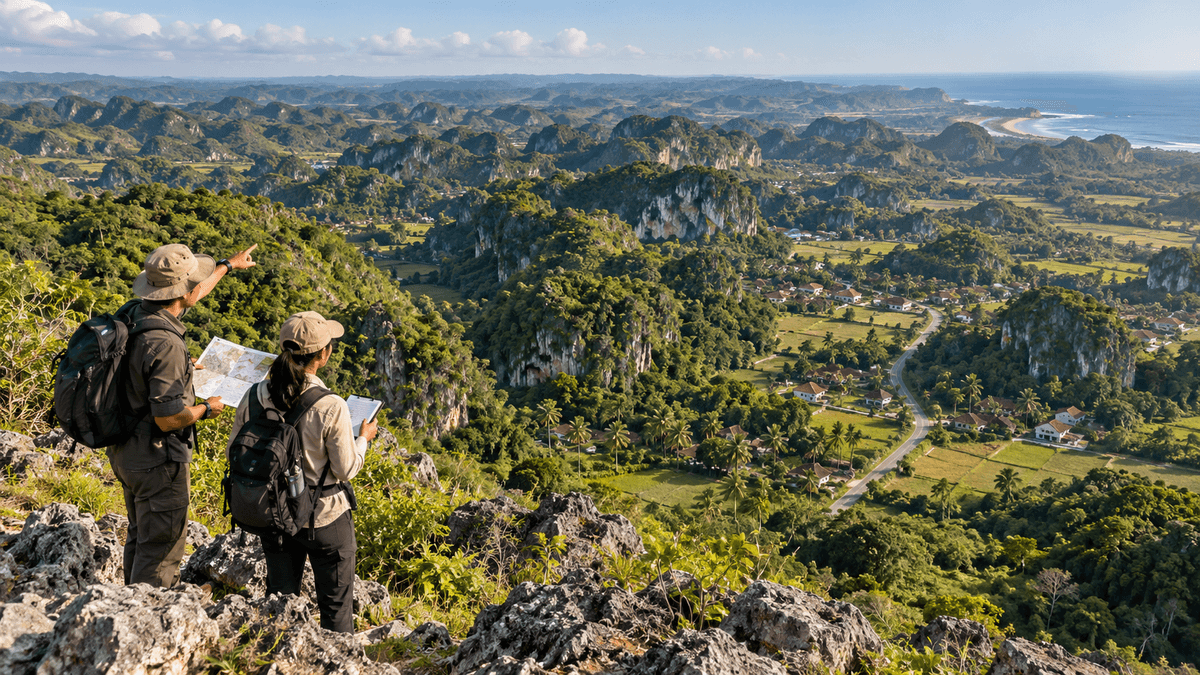
Recognition is an asset only if it changes outcomes
An international designation can improve visibility and give a destination a stronger framework for education, conservation, and tourism development. It does not, by itself, prove that local businesses earn more, that residents receive a larger share of visitor spending, or that conservation has additional funding. For Gunung Sewu UNESCO Global Geopark, the relevant policy question is whether the designation creates measurable local value, and how that value can be sustained.
UNESCO’s official list includes Gunung Sewu among the UNESCO Global Geoparks in Indonesia. UNESCO describes a geopark as a unified geographical area managed through protection, education, and sustainable development, with local communities involved in the process. The framework explicitly links geotourism and local enterprise to the stewardship of geological heritage, while also requiring community participation. This is a statement about the purpose and standards of the designation, not a guarantee of economic results in any particular location. (UNESCO, “List of UNESCO Global Geoparks” (opens in a new tab), updated July 24, 2026; and “UNESCO Global Geoparks” (opens in a new tab), checked October 26, 2026.)
Gunung Sewu was first recognized in 2015 and underwent revalidation in 2019 and 2023. In September 2026, RRI reported that the next revalidation assessment was expected in 2027 and that Gunungkidul was preparing by improving information facilities at 11 geosites and two biosites and developing educational itineraries. These actions are relevant indicators of program implementation. They do not establish the size of any resulting increase in local income or tourism demand. (RRI, “Gunungkidul Boosts Geotourism for 2027 UNESCO Revalidation” (opens in a new tab), September 15, 2026; checked October 26, 2026.)
Four mechanisms through which recognition could create value
The designation may affect the local economy through several mechanisms. Each should be tested separately because they require different evidence.
1. More qualified demand. Recognition may encourage visitors to seek geological interpretation, educational trips, guided routes, or longer stays. The indicator is whether the designation changes visitor origin, motivation, itinerary, spending, length of stay, or repeat behavior, beyond total visits. A rise in visitors at a popular beach during a holiday, for example, cannot automatically be attributed to geopark recognition.
2. Better products and skills. A geopark framework may support training, interpretive materials, school programs, local guiding, and new products connecting geological, cultural, and biological heritage. The economic test is whether participants deliver bookable services, earn income, develop repeat customers, or improve job quality. Counting training sessions is an output measure, not evidence of commercial benefit.
3. Stronger local enterprise and supply links. Visitors may spend on guides, accommodation, food, transport, crafts, educational services, or local products. But sales may be captured by businesses outside the immediate community, and some inputs may be procured from outside the region. To assess local value, the geopark team needs information on ownership, supplier locations, employment, procurement, and the distribution of margins.
4. Better-supported conservation. Geological heritage can underpin tourism products, but maintaining the asset may require interpretation, monitoring, waste management, safety management, and conservation spending. The relevant question is whether designation leads to additional, traceable resources and improved stewardship, not whether conservation is mentioned in the strategy.
These mechanisms are consistent with UNESCO’s stated framework. They remain hypotheses about local outcomes until suitable data shows that they are occurring in Gunung Sewu.
Distinguish the geopark brand from the local economic effect
A brand is not the same as a product, and a product is not the same as local value capture. Visitors may recognize the UNESCO name but still purchase no locally owned services. An itinerary may include a geosite but spend little time in the surrounding village. A local business may gain sales but buy key inputs elsewhere. The designation can support these activities, but economic analysis must follow the transactions rather than assume a chain of benefits.
Geographical scope also matters. Gunung Sewu crosses three regencies: Gunungkidul in the Special Region of Yogyakarta, Wonogiri in Central Java, and Pacitan in East Java. A result measured for the broader geopark cannot automatically be described as a Gunungkidul-only outcome. Likewise, a district-level visitor or accommodation statistic may cover many kinds of travel and cannot be attributed solely to geotourism without a clear method.
The public sources reviewed for this article describe the designation, revalidation, facility improvements, and educational-tourism plans. They do not provide a matched time series that isolates the effect of UNESCO recognition on visitor spending, local procurement, jobs, business profits, or conservation finance in Gunungkidul. This is a measurement gap, not proof that the designation has no value. It means the magnitude and distribution of any economic effect cannot be confidently stated from the evidence reviewed here.
A practical evaluation framework for Gunung Sewu
A credible evaluation should begin with a small indicator set, an agreed geographic boundary, and a clear time period. It should distinguish implementation from outcomes and avoid attributing every change to the designation.
| Evaluation question | Useful indicators | Important limitation |
|---|---|---|
| Has visitor behavior changed? | Geosite visits, visitor origin, itinerary inclusion, overnight stays, spending by category, repeat visits | Demand may also change because of roads, holidays, online content, or unrelated events |
| Are local businesses gaining? | Local business participation, bookings, sales, employment, wages, supplier payments, and ownership | Revenue is not the same as profit; ownership and input sourcing affect local retention |
| Are education products working? | School and university bookings, learning outcomes, repeat bookings, guide income, and teacher assessments | Training counts alone do not demonstrate demand or learning |
| Is conservation better funded? | Budget allocations, actual expenditure, maintenance, monitoring, and condition indicators | Budget commitments do not prove funds were spent or ecological conditions improved |
| Are benefits distributed? | Participation by village, household and business type, wage group, and local supplier category | Aggregated totals can hide concentration in a small number of operators |
The initial evaluation need not require a complex econometric study. It can start with a baseline, a consistent record of participating businesses and visitors, and an annual report showing methods and limitations. More ambitious causal analysis becomes possible once the data series is reliable.
To estimate whether recognition or a particular program changed demand, evaluators should identify what actually changed: signage, an educational route, a marketing campaign, interpretation, or a new commercial product. They should record the intervention date and compare outcomes before and after it. Where a plausible comparison site or visitor segment exists, it can help distinguish the intervention from broader tourism trends. Any comparison must explain differences in access, seasonality, and visitor mix.
Revalidation should be treated as a delivery test
Preparations for the 2027 revalidation offer a practical opportunity to move from broad claims to measurable commitments. Every major action should have an accountable owner and a defined output. For example, an improved information board should have a completion date and a maintenance plan; a new educational itinerary should have a documented route, content review, bookings, and a feedback method; a training program should track whether participants are subsequently paid for relevant work.
A public-facing geopark report could disclose a modest number of indicators each year: the sites covered, the interpretation and training delivered, the number and type of education groups, participating local enterprises, local procurement, payments to guides and suppliers, conservation expenditure, and the status of identified problems. Indicators need definitions and consistent boundaries. Publishing an impressive total without the underlying scope will make year-to-year comparison unreliable.
Community involvement is a consultation requirement and also affects the quality of the product and the legitimacy of its use. Local residents and knowledge holders should have a meaningful role in deciding what is interpreted, how visitors behave at sensitive places, how cultural knowledge is presented, and which opportunities can be delivered without disrupting everyday life. UNESCO’s own framework emphasizes local participation and respect for local ways of life; economic metrics should therefore be paired with community feedback, not used to override it.
Avoid two opposite mistakes
One mistake is to assume that international recognition automatically delivers jobs, sales, and conservation. That turns a designation into a promotional slogan and makes weak programs difficult to question. The opposite mistake is to dismiss the designation because an attributable economic effect has not yet been quantified. That confuses a lack of measurement with proof of no value.
The defensible position is to state what the designation provides, identify which programs have actually been delivered, and measure the outcomes each program is supposed to change. A branding campaign should be judged by relevant behavior, not impressions alone. A training program should be judged by skills applied and income or service changes, not attendance certificates alone. A conservation budget should be judged by spending and stewardship outcomes, not a line in a plan.
Conclusion
UNESCO Global Geopark status gives Gunung Sewu an international framework for connecting geological heritage, education, conservation, and sustainable development. Its local economic value, however, must be demonstrated through visitor behavior, local business performance, job quality, procurement, and conservation results. The immediate priority is to establish a transparent baseline and attach each revalidation initiative to a measurable outcome. Recognition creates an opportunity; accountable delivery determines whether local communities can capture lasting value from it.
Sources consulted
- UNESCO. “List of UNESCO Global Geoparks and Regional Networks.” Page updated July 24, 2026. Direct URL: https://www.unesco.org/en/iggp/geoparks (opens in a new tab). Checked October 26, 2026. Used to confirm Gunung Sewu’s inclusion in the official UNESCO Global Geopark list.
- UNESCO. “UNESCO Global Geoparks.” Direct URL: https://www.unesco.org/en/iggp/geoparks/about (opens in a new tab). Page updated August 20, 2026. Checked October 26, 2026. Establishes the protection, education, sustainable-development, and community-participation framework; it does not quantify local impacts in Gunungkidul.
- UNESCO. “Gunung Sewu UNESCO Global Geopark.” Direct URL: https://www.unesco.org/en/iggp/gunung-sewu-unesco-global-geopark?hub=67817 (opens in a new tab). Checked October 26, 2026. Confirms the 2015 designation date and describes the geopark’s geographic, geological, educational, and community context.
- RRI. “Gunungkidul Boosts Geotourism for 2027 UNESCO Revalidation.” Published September 15, 2026. Direct URL: https://rri.co.id/en/archipelago/2731787/gunungkidul-boosts-geotourism-for-2027-unesco-revalidation (opens in a new tab). Checked October 26, 2026. Reports revalidation preparations, upgraded information facilities, and educational-itinerary development; it does not quantify local economic outcomes.
Keep reading
Related articles: