Can Gunungkidul Build a Geology Education Market? Ngingrong and School Field Trips
Ngingrong could support structured geology field trips, but a school-ready product needs clear learning outcomes, trained interpretation, reliable logistics, safety controls, and evidence of repeat demand, not just a distinctive landscape.
The opportunity is a reliable learning product
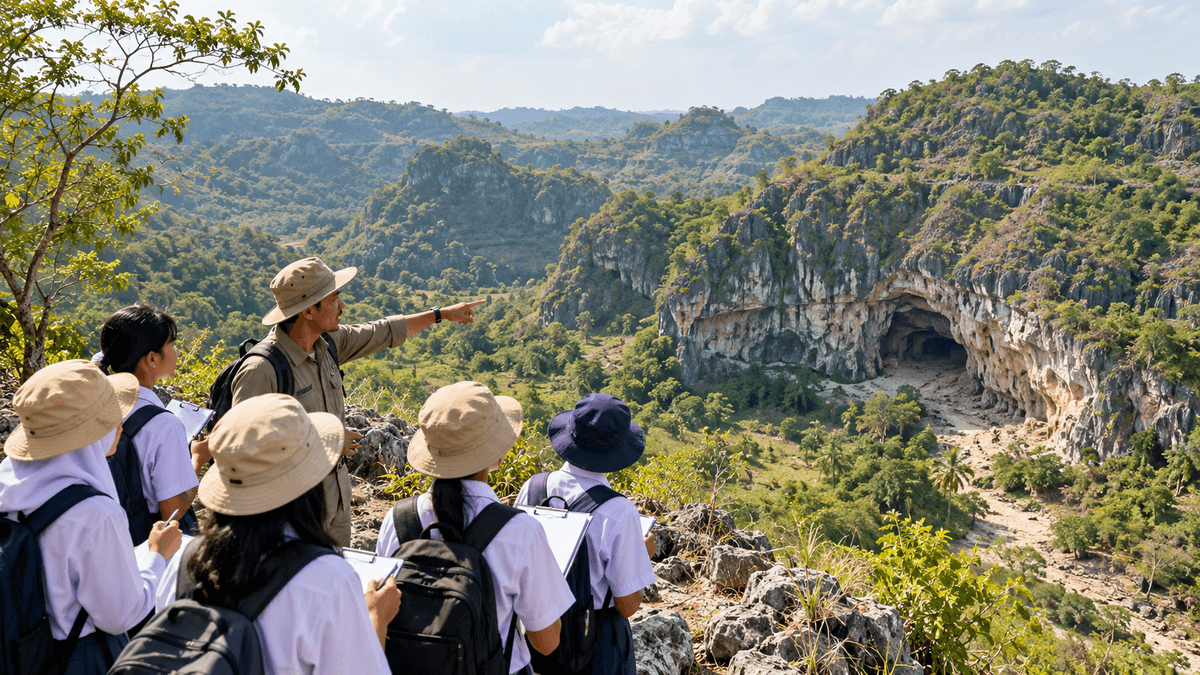
A distinctive landscape does not automatically become a dependable educational destination. Schools and universities need more than scenery: they need learning outcomes, a workable schedule, qualified interpretation, clear risk controls, and a price that can be approved within an institutional budget. For Ngingrong in Gunungkidul, the strategic question is whether the site can support a repeatable geology field-trip product, which an interesting landscape alone cannot guarantee.
The Gunungkidul Tourism Office describes Ngingrong as a geological heritage site featuring the Mulo dry valley, a seasonal river system, cave features, and a karst landscape. It also identifies Ngingrong Rocks Park as an educational facility connected to the geosite. The same description notes local stone terracing used to protect thin agricultural soils from runoff, creating a useful link between geological processes and local land-management knowledge. These details provide a foundation for interpretation, but the official page was published in December 2022. It should not be treated as confirmation of current operating hours, fees, access conditions, or the capacity to receive school groups. (Gunungkidul Tourism Office, “Geosite Ngingrong” (opens in a new tab), published December 27, 2022; checked October 26, 2026.)
The timing is relevant. In September 2026, RRI reported that Gunungkidul was preparing for the 2027 revalidation of the Gunung Sewu UNESCO Global Geopark. The report said information facilities at 11 geosites and two biosites had been upgraded and that educational tourism itineraries were being developed. That is evidence of a current policy direction, not proof that a complete Ngingrong school program is already operating or generating revenue. (RRI, “Gunungkidul Boosts Geotourism for 2027 UNESCO Revalidation” (opens in a new tab), September 15, 2026; checked October 26, 2026.)
UNESCO’s profile of Gunung Sewu also describes a “School to Geopark” program in which students accompanied by geography and biology teachers visit geosites and participate in learning activities linking geology, biology, and culture. This establishes that school-oriented learning is part of the geopark’s documented educational approach. It does not establish that a specific Ngingrong package is currently open for booking or that demand and learning outcomes have been measured there. (UNESCO, “Gunung Sewu UNESCO Global Geopark” (opens in a new tab), checked October 26, 2026.)
What schools would actually buy
The market should be defined by the job the trip is expected to do. A primary-school visit may emphasize observation, vocabulary, and safe engagement with a landscape. A secondary-school visit can connect landforms to erosion, rock structure, water movement, and human adaptation. University groups may need more technical interpretation, field notes, or a defined case-study assignment. Treating all three as the same “education package” makes it harder to price the service, train interpreters, and demonstrate learning value.
A Ngingrong education product could be organized into three modules, subject to site-manager confirmation and expert review:
- Landscape observation: identify visible landforms, describe the relationship between slopes and drainage, and record observations using a guided worksheet.
- Karst and water systems: explain how surface water, seasonal flow, cave systems, and soluble rock can interact. The teaching material must distinguish established site facts from simplified classroom models.
- People and landscape: examine how local land practices, such as the stone terracing described by the tourism office, relate to soil retention and farming constraints.
These are proposed learning modules, not a claim that the current site already delivers them. A geologist or qualified educator should review the content, and a local interpreter should help connect the science to place-based knowledge without presenting community practices as mere scenery.
A field trip also needs a deliverable. Teachers should receive a short pre-visit brief, an activity sheet, a risk and conduct briefing, a post-visit exercise, and a simple method for assessing student learning. If a visit cannot show what students learned, it may be perceived as a recreational outing with a geological label rather than a defensible educational purchase.
The operating model: package the whole service
A school-ready product is a coordinated service bundle. Depending on what is confirmed as available, it may include the site visit, an interpreter or guide, learning materials, a group briefing, designated observation points, basic sanitation, and an agreed emergency-response procedure. Transport, meals, and additional activities can be offered by qualified local providers, but they should be listed separately when they are not part of the core package.
The operating design should specify a maximum group size, the number of adults required, the route used, accessible alternatives where feasible, wet-weather procedures, and cancellation rules. These are not administrative details to be decided after marketing begins. They determine the real cost and whether the product is appropriate for the site.
Pricing should begin with costs rather than an aspirational market price. The operator should calculate fixed preparation costs, per-group delivery costs, guide and instructor pay, materials, cleaning, safety equipment, insurance where applicable, and any authorized site fees. A simple break-even test is:
Break-even groups = fixed costs for the period ÷ contribution per group.
Contribution per group is the selling price less costs that vary with each booking. The result should be stress-tested for smaller classes, cancellations, transport price changes, and school-budget limits. No price should be published until current fees, inclusions, taxes where applicable, and service providers have been verified.
A group-rate structure may be easier for schools than individual ticketing, but group pricing must not hide compulsory charges. The quotation should identify what is included, what the school must arrange, and which activities carry additional safety requirements.
Build demand through the school calendar
The most credible route to demand is institutional. Potential buyers include schools, universities, teacher networks, science clubs, and organized learning programs. Each has its own approval cycle and safeguarding requirements. A provider that waits for spontaneous weekend bookings will struggle to plan staffing, while a provider that assumes every school will purchase a field trip will overestimate the market.
A practical pilot should begin with a limited number of groups and defined learning modules. Before opening bookings, the site team should confirm the route, staffing, emergency arrangements, maximum group size, and rain or seasonal closure rules. After each visit, collect structured feedback from the teacher and a sample of students. Record whether the group met the learning outcomes, whether the timing worked, what created friction, and whether the teacher would recommend or rebook the product.
School outreach should include a concise educator pack rather than a general tourism brochure. It should list learning objectives, suggested age ranges, activity duration, teacher responsibilities, accessibility notes, safety exclusions, price inclusions, booking lead time, and the cancellation policy. The pack should not promise cave access or adventure activities unless the manager has confirmed that the activities are authorized and suitable for the group.
Safety and site readiness are part of the commercial proposition
Ngingrong includes a valley and cave setting, and the official description notes a seasonal river. That is enough to require site-specific safety planning; it is not enough to infer current hazard levels or determine when a route is safe. Fieldwork should be restricted to confirmed routes and conditions. Cave entry, cliff-edge observation, flying-fox use, or other adventure activities should be treated as separate activities with their own operator competence and risk controls, not automatic parts of a school package.
Before launch, the operator should document access control, weather monitoring, footwear and equipment requirements, first-aid capability, communications coverage, staff roles, student head counts, emergency contacts, and procedures for stopping an activity. The responsible authority should confirm current rules and the status of any equipment. If the site cannot provide the agreed level of supervision, the group size or activity plan should be reduced rather than making safety a negotiable add-on.
The public sources reviewed for this article do not establish Ngingrong’s current school-group capacity, fees, access routes, insurance arrangements, wet-weather rules, or the present availability of every activity. The analysis therefore assesses the feasibility of an education product; it is not a current booking guide. A school or provider should confirm those operational details with the site manager before committing to a visit.
Measure educational value and commercial viability separately
The program should not be judged only by the number of students who visit. A compact dashboard could record:
- inquiries, quotations, bookings, cancellations, and repeat bookings;
- group size, school or institution type, and season of visit;
- direct cost per group and contribution after variable costs;
- teacher satisfaction and student learning outcomes;
- local guide hours paid, local suppliers used, and payments made to them;
- incidents, near misses, route changes, and weather-related cancellations.
These measures answer different questions. A high booking count may conceal low margins or weak learning outcomes. Strong teacher feedback may indicate educational quality but not prove that the offer can cover its costs. Local guide payments may show that some value is retained, but they do not alone establish the total economic impact on the community.
A pre- and post-visit assessment can ask students to identify landforms or explain a basic process before and after the program. Teachers can use a short rubric rather than a lengthy test. Commercial evaluation should compare actual costs and revenues for each group size and note the staff hours that are often omitted from informal accounting.
A phased launch is more defensible than immediate expansion
The first stage should verify the site and co-design one pilot module with a geologist, educator, site manager, and local interpreter. The second should test the program with a small set of schools, tracking costs, learning, timing, and safety. Only after the pilot produces reliable evidence should operators expand the number of modules or market the site to a larger institutional audience.
Gunungkidul’s preparation for geopark revalidation provides a reason to strengthen educational interpretation, but the revalidation process should not be mistaken for demand validation. A program becomes commercially credible when schools can understand what they are buying, educators can explain what students will learn, site managers can deliver it safely, and local providers can earn a fair return without putting pressure on the geological asset.
Conclusion
Ngingrong has a documented geological and educational basis for a field-trip offer. The next task is to convert that basis into a defined product with reviewed content, clear operational limits, transparent pricing, dependable booking, and measurable learning outcomes. Start with one safe, curriculum-linked pilot and publish performance evidence before scaling. That approach is more likely to build a repeat customer base than marketing the landscape as an education destination without proving the service behind the claim.
Sources consulted
- Dinas Pariwisata, Ekonomi Kreatif, Pemuda, dan Olahraga Kabupaten Gunungkidul. “Geosite Ngingrong.” Published December 27, 2022. Direct URL: https://wisata.gunungkidulkab.go.id/geosite-ngingrong/ (opens in a new tab). Checked October 26, 2026. The page documents the site’s geological features and describes Ngingrong Rocks Park as an educational facility; practical conditions require re-verification because the page is dated.
- RRI. “Gunungkidul Boosts Geotourism for 2027 UNESCO Revalidation.” Published September 15, 2026. Direct URL: https://rri.co.id/en/archipelago/2731787/gunungkidul-boosts-geotourism-for-2027-unesco-revalidation (opens in a new tab). Checked October 26, 2026. Reports the 2027 revalidation preparation and educational-itinerary work; it does not establish Ngingrong-specific booking demand.
- UNESCO. “UNESCO Global Geoparks.” Direct URL: https://www.unesco.org/en/iggp/geoparks/about (opens in a new tab). Page updated August 20, 2026; checked October 26, 2026. Used for the designation’s protection, education, sustainable-development, and community-participation framework.
- UNESCO. “Gunung Sewu UNESCO Global Geopark.” Direct URL: https://www.unesco.org/en/iggp/gunung-sewu-unesco-global-geopark?hub=67817 (opens in a new tab). Checked October 26, 2026. The profile records the designation date as 2015 and describes the School to Geopark learning approach; it does not verify current Ngingrong bookings or outcomes.
Keep reading
Related articles: