From Entry-Level Work to Skilled Tourism Careers in Gunungkidul
Tourism can offer young people routes into guiding, hospitality, digital content, creative production, events, and entrepreneurship. The policy challenge is to connect training to real demand, build progression beyond entry-level tasks, and retain local talent without assuming every young person must work in tourism.
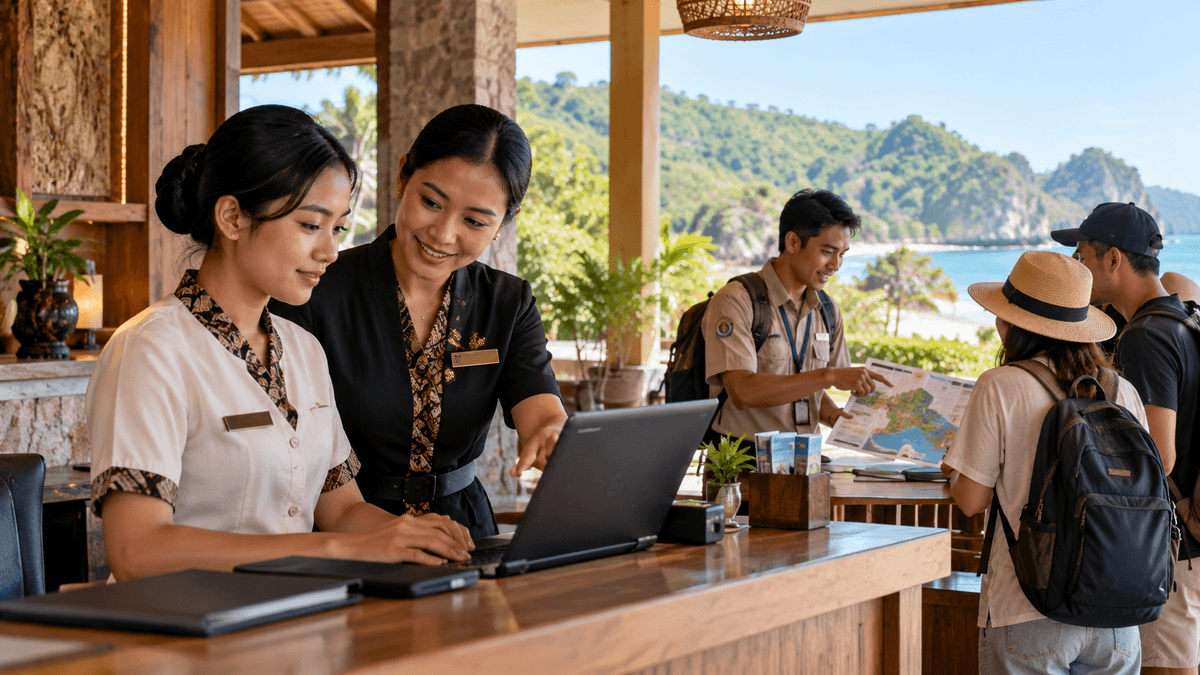
Tourism jobs should be a starting point for careers
Tourism can create entry points into work for young people: assisting a guide, serving guests, preparing food, managing bookings, taking photographs, editing short videos, supporting an event, or selling local products online. The long-term opportunity is larger than filling entry-level positions. A local tourism economy is stronger when young workers can build skills, move into more responsible roles, develop portable qualifications, or establish viable businesses.
For Gunungkidul, the issue is whether those who choose this sector can see credible routes from initial experience to skilled work, and whether local employers and public programs can connect training to actual demand.
This is a different question from measuring the overall quality of tourism jobs. It focuses on transitions: how young people enter a sector, how they identify skills gaps, how they acquire experience, what allows them to advance, and what encourages them to stay in or return to Gunungkidul.
What the local labor data can and cannot show
Statistics Indonesia’s Labor Force Situation in Gunungkidul Regency 2025 (opens in a new tab), released on 1 April 2026, is based on the August 2025 National Labor Force Survey (Sakernas). It provides estimates down to the regency level and includes tables by age, education, work status, and main industry. These tables are a useful starting point for understanding broad labor-market patterns, although they do not identify every tourism occupation separately.
In Table 23 (page 51 of the publication), the broad “services” grouping includes wholesale and retail trade, transport and storage, accommodation and food service activities, information and communication, finance, real estate, public administration, education, health, and other services. Summing the two youngest age bands shown, 15-19 and 20-24, gives an estimated 23,774 employed people in the services grouping out of 44,571 employed people across those two age bands, or about 53.3%. The values are estimates from Sakernas, not a census of individual workers.
That calculation is a useful contextual indicator, but it must not be presented as a tourism employment figure. The services grouping is much wider than tourism, and the survey table describes the main industry of people who were working during the reference week. It does not measure young people’s career aspirations, job quality, training outcomes, or the number of jobs directly attributable to tourism.
The same limitation applies to the overall open unemployment rate. A district-wide rate cannot show the position of youth separately, and it cannot tell whether young workers can obtain the skills or advancement they want. A youth-focused article therefore needs age-disaggregated evidence, interviews, and employer-side information rather than a broad unemployment statistic alone.
Four career pathways that can be made more visible
The pathways below are analytical categories for designing training and employer partnerships, not a claim that current vacancies exist in every role. Actual openings, pay, required qualifications, and seasonal demand must be verified with employers and relevant training providers.
1. Guiding, interpretation, and visitor safety
An entry-level assistant can progress toward a trained guide or activity specialist by developing destination knowledge, storytelling, visitor communication, group management, first aid, risk awareness, and relevant language skills. For nature and adventure activities, safety competencies must be matched to the actual activity and applicable standards; a generic short course is not a substitute for required qualifications.
A good pathway links learning to supervised practice. Participants should demonstrate that they can explain a place accurately, manage visitor expectations, respond to common problems, and escalate risks appropriately. Where a recognized competency assessment exists, training providers should explain the route to assessment and the employer should recognize the resulting credential.
2. Hospitality, reservations, and operations
Young workers can begin in guest services, housekeeping, food service, reception, or activity operations. Progression may lead to shift supervision, reservation management, purchasing, revenue support, guest-experience coordination, or operations management.
The key skills change as responsibility grows. A supervisor needs more than service etiquette: scheduling, stock control, complaint resolution, basic financial literacy, digital booking systems, and the ability to document service issues become important. Employers can make progression clearer by defining the competencies expected at each level rather than relying on informal tenure alone.
3. Digital content, photography, design, and destination communication
Tourism and creative-economy businesses need content that is accurate, useful, and consistent with the real visitor experience. Young people may contribute through photography, video editing, graphic design, social media operations, website updates, product descriptions, and customer inquiries.
A portfolio can provide evidence of practical ability, but digital visibility alone is not a reliable business outcome. Training should connect creative tasks to real operational needs: producing accurate visitor information, helping users complete a booking, communicating changes, or measuring conversion and customer questions. Workers should understand image rights, consent, personal-data protection, and how not to misrepresent destination conditions.
Career progression can include specialization in editing, brand design, performance measurement, digital sales, or content production management. Employers and training providers should also discuss attribution and ownership when a young worker creates original material for a business.
4. Events, product development, and tourism entrepreneurship
Event assistants may progress into supplier coordination, production scheduling, client service, budgeting, or event operations. Young entrepreneurs may develop guided experiences, food products, workshops, creative goods, or visitor services. These pathways require more than inspiration: they involve pricing, costing, procurement, licensing where applicable, customer research, and cash-flow management.
A small enterprise should be tested before substantial capital is committed. A pilot product can establish whether customers will pay, whether delivery costs are understood, and whether demand persists beyond a public event or peak holiday period. Mentors should help participants distinguish revenue from gross margin and gross margin from cash available after fixed costs.
Local training exists, but career impact is unproven
Local-government reporting confirms that training activities have been delivered, but the accessible reports document program content and participation rather than career outcomes. A Gunungkidul tourism-office report published on 20 August 2025 says 30 local tourism and creative-economy participants attended an activity described as an SKKNI-based tourism human-resources training in Kalurahan Giripurwo on 14-15 August 2025. Topics included local-potential-based tourism packaging, guiding and storytelling, marketing, partnerships, and networking (Dinas Pariwisata Gunungkidul, 2025 (opens in a new tab)). A second report, published on 22 October 2025, describes an 8-9 October activity in Kalurahan Giricahyo focused on event management, promotional strategy, team operations, and draft event proposals (Dinas Pariwisata Gunungkidul, 2025 (opens in a new tab)).
These official reports establish that the named activities were reported by the agency. They do not establish participants’ ages, whether a formal qualification was awarded, whether participants completed an assessment, whether they entered paid work, or whether their careers progressed. They are examples of organized learning, not proof of a functioning career ladder. Even when a course is confirmed, attendance is only an output; career impact requires follow-up evidence such as demonstrated skill, paid placement, repeat employment, increased responsibility, business survival, or progression to a better role.
Build a skills-to-work pipeline
A practical local system needs four connected stages.
Stage 1: Identify real demand with employers
Tourism businesses, destination managers, creative-economy enterprises, event organizers, and transport operators should list recurring tasks, hard-to-fill roles, seasonal requirements, and competencies that distinguish a beginner from a worker ready for more responsibility. The exercise should include small firms as well as large operators.
Stage 2: Map training to demonstrated competencies
Training should be designed backwards from actual tasks. A guide needs to demonstrate interpretation and safe group management; a digital content worker needs a portfolio; a hospitality candidate needs to handle real service scenarios; an event coordinator needs to produce an operational plan and cost sheet.
Generic certificates may signal attendance without demonstrating ability. Where recognized national competency standards or assessments are relevant, providers should specify exactly what credential is awarded, who assesses it, what it covers, and whether employers accept it.
Stage 3: Provide supervised, paid experience where feasible
Work-based learning helps young people test whether a role fits their interests and allows employers to see performance before committing to long-term recruitment. The arrangement should specify tasks, supervision, duration, reimbursement or pay, safety, feedback, and the conditions under which a placement may lead to employment.
Short placements should not become a substitute for regular paid labor. Employers should explain which learning outcomes are expected and how the participant’s contribution will be recognized.
Stage 4: Track progression as well as participation
Follow participants after three, six, and twelve months where feasible. Useful indicators include:
| Indicator | What it reveals |
|---|---|
| Completion and competency assessment | Whether participants completed training and demonstrated the intended skill |
| Paid placement or job match | Whether learning connected to a real opportunity |
| Repeat employment and hours worked | Whether work continued beyond a single event or short peak season |
| Movement to higher-responsibility tasks | Whether a career pathway exists beyond entry-level work |
| Income range and work seasonality | Whether young workers can plan and retain earnings |
| Business survival and repeat customers | Whether entrepreneurship is commercially viable |
| Retention or return to Gunungkidul | Whether local opportunities help people build careers near home, if that is their preference |
Personal information must be collected only for a defined purpose and handled responsibly. Small cohorts should be reported carefully so individuals cannot be identified from a combination of age, role, village, or employer.
What government, training providers, and employers should do next
Government can coordinate employer demand surveys, publish training opportunities and eligibility clearly, connect providers to relevant competency standards, and require basic outcome tracking for publicly supported programs.
Training providers and schools can give students realistic exposure to several roles rather than promoting tourism as a single occupation. They can help learners build portfolios, practice customer communication, understand workplace expectations, and develop transferable digital, language, financial, and problem-solving skills.
Employers can create transparent entry requirements and role descriptions, identify progression routes, provide supervised practical experience, and explain what evidence is needed to move from entry-level to skilled work. Small businesses can pool training or mentorship where a single firm lacks the capacity to provide it alone.
Young people should be able to compare paths honestly. Tourism work may offer meaningful careers, but it is not the right fit for everyone, and not every business will have a permanent role. The goal is to improve access to informed choices, portable skills, and credible progression, not to channel all youth into one sector.
Conclusion: A career pipeline must lead somewhere
Official reports document examples of local training in guiding and storytelling, tourism product packaging, marketing, and event management. These activities provide a starting point, but their long-term value depends on whether they connect to actual work, demonstrated competencies, better responsibilities, and sustainable businesses. The published reports reviewed do not follow participants into employment or measure career progression.
The next step is a local skills-to-work partnership that maps employer demand, aligns training with demonstrated competencies, provides supervised experience, and follows participants after the course ends. That will produce more useful evidence than counting trainees alone, and give young residents a clearer basis for deciding whether to build a career in tourism, the creative economy, another local sector, or outside the region.
Sources consulted
- Badan Pusat Statistik Kabupaten Gunungkidul. Keadaan Angkatan Kerja Kabupaten Gunungkidul 2025 [Labor Force Situation in Gunungkidul Regency 2025]. Released 1 April 2026; survey reference period August 2025. Table 23, “Population 15 Years of Age and Over Who Worked During the Previous Week by Main Industry and Age Group,” printed page 51. https://gunungkidulkab.bps.go.id/id/publication/2026/04/01/27f92051bb609ea7bb4d11a4/keadaan-angkatan-kerja-kabupaten-gunungkidul-2025.html (opens in a new tab). PDF table checked 26 October 2026.
- Dinas Pariwisata, Ekonomi Kreatif, Pemuda, dan Olahraga Kabupaten Gunungkidul. “Pelatihan Peningkatan Kapasitas SDM Pariwisata Berbasis SKKNI Digelar di Desa Giripurwo Kabupaten Gunungkidul.” Published 20 August 2025; activity held 14-15 August 2025. https://wisata.gunungkidulkab.go.id/pelatihan-peningkatan-kapasitas-sdm-pariwisata-berbasis-skkni-digelar-di-desa-giripurwo-kabupaten-gunungkidul/ (opens in a new tab). Checked 26 October 2026.
- Dinas Pariwisata, Ekonomi Kreatif, Pemuda, dan Olahraga Kabupaten Gunungkidul. “Pelatihan Pengembangan Kapasitas SDM Pariwisata Program PIS Kalurahan Giricahyo, Kapanewon Purwosari, Kabupaten Gunungkidul.” Published 22 October 2025; activity held 8-9 October 2025. https://wisata.gunungkidulkab.go.id/pelatihan-pengembangan-kapasitas-sdm-pariwisata-program-pis-kalurahan-giricahyo-kapanewon-purwosari-kabupaten-gunungkidul/ (opens in a new tab). Checked 26 October 2026.
Keep reading
This article is part 3 of 9 in the series "Community and Livelihoods in Gunungkidul".