From Cocoa Farm to Visitor Experience: Testing Nglanggeran’s Agriculture-Tourism Link
Nglanggeran’s cocoa economy offers a specific test of agritourism: can farm visits, processing demonstrations, and chocolate products improve producer margins without turning agriculture into a stage set or weakening the underlying supply chain?
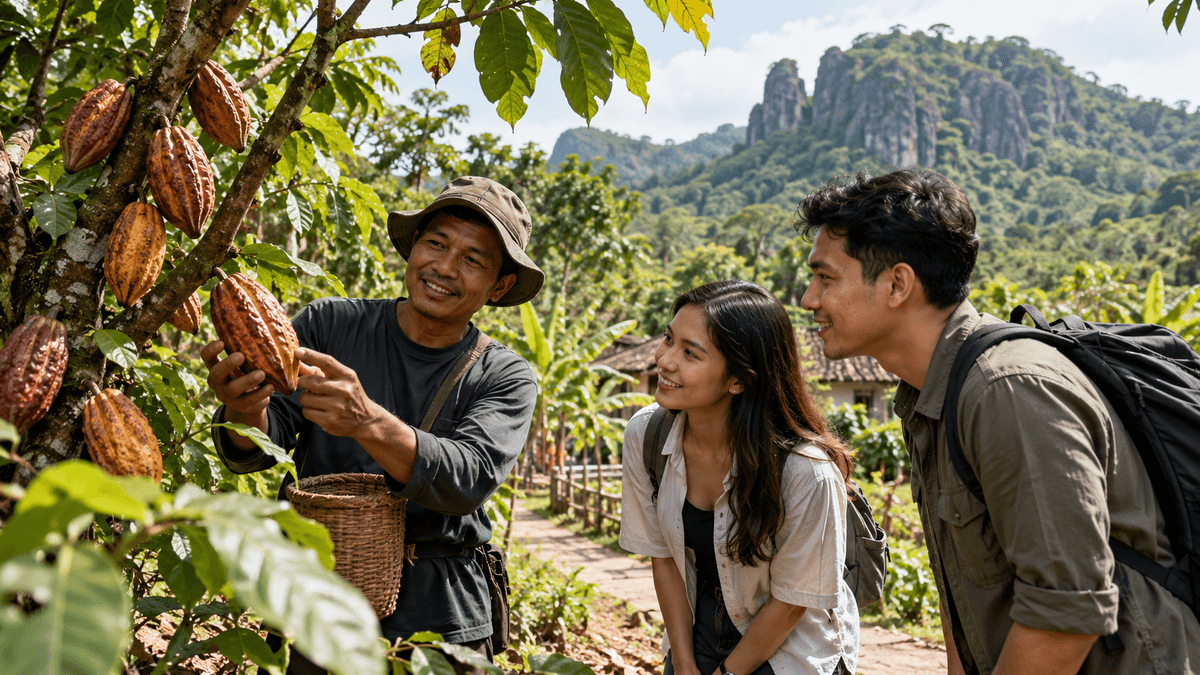
The test is whether tourism strengthens the cocoa chain
Agritourism is often described as a way to bring visitors closer to local production. The harder question is whether those visits improve the economics of farming and processing, or simply create an additional promotional layer around products that still face the same challenges in quality, supply, and market access.
Nglanggeran offers a useful case because cocoa is part of a local processing chain as well as a theme for visitors. A 2026 undergraduate case study deposited in Universitas Diponegoro’s repository describes several actors in Nglanggeran’s chocolate agroindustry: farmers, collectors, storage, an intermediate-product unit known as Tim Bubuk, and final-processing businesses including Griya Cokelat Nglanggeran, KWT Putri Kencana, and Omah Kakao Doga. The study used purposive sampling with 37 key informants and data from interviews, observation, documentation, and business financial reports during research in April 2026. (Anjani et al., “Analisis Rantai Nilai dan Nilai Tambah Agroindustri Cokelat di Desa Wisata Nglanggeran Kabupaten Gunungkidul,” Universitas Diponegoro repository (opens in a new tab), 2026; checked October 26, 2026.)
The findings indicate that value is added at different stages, rather than at the final chocolate bar alone. The repository summary reports value-added ratios for several processing activities, including fermented beans, cocoa powder, chocolate bars, and chocolate drinks. These ratios are specific to the study’s method and sampled businesses. They are not equivalent to net profit, the share of retail revenue paid to farmers, or proof that tourism caused an increase in household income.
The local government’s 2026 Festival Cokelat and Geopark Night Specta event also presented cocoa as a link between agriculture, tourism, and the creative economy. The event took place at the Embung Nglanggeran tourism area on July 10, 2026, and included recognition for a cocoa plantation and fermented-bean quality competition. This demonstrates that public programming has been organized around the crop; it does not by itself show the amount of additional income received by participating farmers. (Gunungkidul Regency Government, “Sinergi Pariwisata dan Pertanian, Geopark Night Specta ke-8 dan Festival Cokelat ke-4 Resmi Dibuka di Nglanggeran” (opens in a new tab), July 10, 2026; checked October 26, 2026.)
Map the value chain before adding tourism products
A cocoa visitor experience should be designed around the actual production chain, not around an assumption that every farm can host visitors or every processor is ready to offer public demonstrations. The chain documented in the 2026 study starts with production and trading, moves through intermediate processing, and reaches final products and consumers. Each stage faces different costs and risks.
Farmers may carry production risk, labor costs, crop-quality uncertainty, and the time required for fermentation and drying. Collectors or storage operators perform aggregation and handling functions. Intermediate processors transform beans into ingredients, while final processors manage recipes, food safety, packaging, branding, distribution, and sales. Tourism can add a new channel for learning and sales, but it also creates extra work: scheduling groups, preparing demonstrations, training interpreters, maintaining visitor areas, and protecting production hygiene.
This is why the business case needs more than a “farm-to-chocolate” story. It needs to identify which actor receives payment for which activity, which costs are new, and which parts of the chain can meet visitor demand consistently. If the visitor program is sold by one operator but cocoa is bought from farmers at unchanged terms, the tourism value may not reach the producer. If a processing group receives the booking income but must divert staff from production, the added revenue may be smaller than it appears.
Design the experience around real production tasks
Potential products could include a guided explanation of cocoa cultivation, a demonstration of fermentation or drying, a small-group chocolate-processing session, a tasting, or a workshop on how product quality and ingredients affect the final result. Some components may already be offered by local businesses, but their current availability, price, and operating capacity must be confirmed before they are described as bookable products. The objective is to package activities that local producers can deliver accurately, safely, and at a sustainable margin.
The most useful visitor experience shows the decisions that change value: why fermentation matters, how drying affects quality, what makes a bean suitable for a particular product, how much labor goes into processing, and why retail prices are not a direct proxy for farmer income. A tasting or workshop can make these choices tangible without pretending that all farmers receive the same price or that all sales are locally sourced.
Product design should use different formats for different customers. A short tasting and processing explanation may suit individual travelers. A more structured farm-and-processing module may suit school or university groups. A technical workshop could serve food entrepreneurs, hospitality teams, or agricultural learners. These are proposed formats, not claims about existing availability. Each needs a documented schedule, facilitator, group-size limit, materials list, hygiene protocol, and price quotation.
Measure farmer returns as well as visitor purchases
The economic evaluation should separate at least four outcomes: value added in processing, income earned by farmers, revenue earned by tourism activities, and net income retained locally. They are related but not interchangeable.
A locally made chocolate bar may command a higher price than raw beans because it includes ingredients, processing, quality control, packaging, distribution, and retail services. That price difference does not automatically indicate an excessive margin or prove that farmers are underpaid. The analysis must establish the costs and risks attached to each stage before deciding how value should be distributed.
The 2026 Universitas Diponegoro case study provides a starting point for asking where value is created along the chain. It is a site-specific case study based on purposively selected 37 key informants and business financial records, not a census of all cocoa producers in Gunungkidul. The publicly accessible repository abstract reports the following value-added percentages for activities and processors in the study. (Anjani et al., 2026 (opens in a new tab); abstract checked October 26, 2026.)
| Activity or processor | Value-added percentage reported in the study abstract |
|---|---|
| Farmers fermenting cocoa beans independently | 42.40% |
| Farmer group in Karangsari | 26.46% |
| Tim Bubuk, cocoa powder | 50.10% |
| Griya Cokelat Nglanggeran, chocolate bar | 55.35% |
| Griya Cokelat Nglanggeran, chocolate beverage | 33.61% |
| KWT Putri Kencana, chocolate bar | 65.81% |
| KWT Putri Kencana, chocolate beverage | 31.33% |
| Omah Kakao Doga, chocolate bar | 52.52% |
These are ratios reported by the study, not net-profit margins, farmer shares of retail revenue, or the percentage of tourism spending retained locally. The repository record notes that value-added analysis used the Hayami method, but the figures above have not been independently recalculated from the full underlying tables. They are useful as a site-specific starting point, not as universal targets or a measure of tourism’s causal effect on farmer income.
A tourism-linked cocoa program should track:
- the volume and value of cocoa purchased from local farmers, by grade and quality;
- the share of beans sourced locally versus brought in from elsewhere;
- the price paid to farmers, payment timing, rejection rates, and quality premiums;
- value added at each processing stage using a consistent method;
- visitor bookings, sales per participant, product purchases, and repeat orders;
- the additional labor, ingredients, cleaning, packaging, marketing, and maintenance costs created by visitor activities;
- the share of program revenue paid to farmers, processors, guides, community groups, and other local providers.
A simple before-and-after comparison can help, but it does not establish causation if cocoa prices, crop volumes, weather, input costs, or buyer contracts change at the same time. Where feasible, record the same indicators for participating and non-participating producers or compare similar periods while explaining the limitations.
The main risks are production constraints and weak attribution
Cocoa production is seasonal and exposed to agronomic risks. Tourism bookings, in contrast, may cluster on weekends, holidays, and event dates. The two calendars do not necessarily align. A farm may not have ripe pods when a tour is booked; a processing unit may be committed to a wholesale order; a festival may attract interest without generating repeat purchases after the event.
Food safety and product consistency also matter. Processing demonstrations need clear separation between visitor activities and food intended for sale, and any product sold must meet applicable requirements. Packaging and shelf life should be tested rather than assumed. Experiences must avoid damaging crops, interrupting production, or making farmers perform repetitive demonstrations without fair compensation.
A further risk is over-attribution. If a festival combines music, geopark promotion, chocolate sales, agricultural exhibitions, and public funding, the full visitor spending cannot be attributed to cocoa tourism. The event may be valuable for visibility and coordination, but proving a durable business effect requires tracking purchases, new buyers, follow-up orders, and farmer prices after the event.
The public materials reviewed here do not establish which farms, processors, and workshops currently accept visitors or provide a complete current price list. They also do not establish a comparable series of farmer purchase prices and production volumes that would show whether tourism raises producer income. For that reason, the experience formats discussed here are proposed business options, not a list of bookable products or proven income gains.
Turn the cocoa-tourism link into a testable business model
The best next step is a limited pilot co-designed by cocoa farmer groups, processors, tourism managers, and educators. Start with one product that can be delivered without disrupting production (for example, a scheduled processing demonstration plus tasting) and set a transparent fee split among the participating businesses. Document what the fee covers, including staff time and preparation.
The pilot should establish a baseline before promotion. Record the number of bookings, participants, product sales, cocoa purchases, local payments, operating costs, and repeat inquiries. Ask visitors whether the experience changed their understanding of cocoa production and whether they would buy the product again. Follow up with wholesale or direct-to-consumer buyers to determine whether the experience creates demand beyond the day of the visit.
If the pilot covers its direct costs and shows a credible path to repeat bookings or product sales, add modules gradually. If it produces attention but little contribution to farmer income or processor margins, improve the buyer link, pricing, or product before expanding marketing. The purpose of measurement is to prevent a public narrative about empowerment from substituting for evidence about who is paid and how much, while respecting cultural and educational value.
Conclusion
Nglanggeran’s cocoa chain provides a concrete basis for connecting agriculture with visitor experiences. The opportunity is strongest when tourism reinforces production, quality, processing, and repeat product sales rather than becoming a separate show with uncertain benefits for farmers. A credible strategy will map each actor’s contribution, compensate local knowledge and labor, verify current product availability, and measure value added alongside the actual returns received by producers.
Sources consulted
- Anjani, Weni Audi, Kustopo Budiraharjo, and Hery Setiyawan. “Analisis Rantai Nilai dan Nilai Tambah Agroindustri Cokelat di Desa Wisata Nglanggeran Kabupaten Gunungkidul.” Universitas Diponegoro Repository, undergraduate thesis, 2026. Direct URL: https://eprints2.undip.ac.id/id/eprint/57835 (opens in a new tab). Research conducted in April 2026; repository deposited August 12, 2026. Checked October 26, 2026. Summary reports purposive case-study methods with 37 key informants and value-added analysis across cocoa processing stages. Detailed calculations should be checked against the complete thesis before publication.
- Pemerintah Kabupaten Gunungkidul. “Sinergi Pariwisata dan Pertanian, Geopark Night Specta ke-8 dan Festival Cokelat ke-4 Resmi Dibuka di Nglanggeran.” Published July 10, 2026. Direct URL: https://gunungkidulkab.go.id/sinergi-pariwisata-dan-pertanian-geopark-night-specta-ke-8-dan-festival-cokelat-ke-4-resmi-dibuka-di-nglanggeran/ (opens in a new tab). Checked October 26, 2026. Documents the 2026 event and cocoa-quality/plantation activities; it does not quantify incremental income to farmers.
- Dinas Pertanian dan Pangan Kabupaten Gunungkidul. “Uji Organoleptik Aneka Produk Baru Berbahan Baku Coklat dan Susu Kambing di UPT TTP Nglanggeran.” Published January 14, 2022. Direct URL: https://pertanian.gunungkidulkab.go.id/2022/01/14/uji-organoleptik-aneka-produk-baru-berbahan-baku-coklat-dan-susu-kambing-di-upt-ttp-nglanggeran/ (opens in a new tab). Checked October 26, 2026. Historical context for cocoa processing, training, and product development; current program availability must be rechecked.
Keep reading
Related articles: