More Spending, Short Trips: What Gunungkidul’s Tourism Numbers Really Say
Gunungkidul’s Tourism Office reported average spending of IDR 579,118 per visit in the second quarter of 2026, while the average visit lasted 1.27 days. The numbers raise a practical question: should destinations focus on more arrivals, higher spending, or longer and better-connected trips?
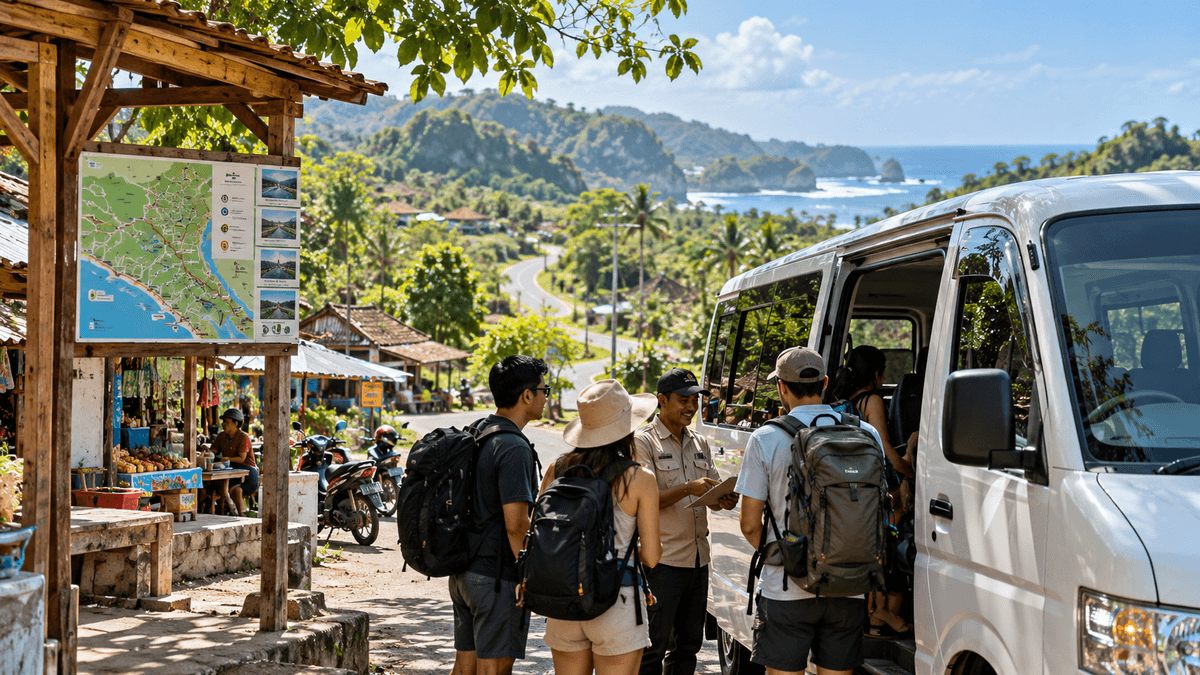
A higher spend per visit is useful but covers only part of the strategy
A destination can attract many visitors while capturing only a modest share of each trip’s potential economic value. It can also encourage longer stays without ensuring that visitors spend money with local businesses. The challenge is to understand how visitor volume, expenditure, trip duration, local supply, and destination capacity fit together.
The Gunungkidul Tourism Office reported that average visitor expenditure reached IDR 579,118 per visit in the second quarter of 2026, while the average length of visit was 1.27 days. For domestic visitors, the reported averages were IDR 548,512 per visit and 1.13 days. The same release reported average international visitor spending of US$54.97 (reported by the agency as approximately IDR 987,189) and an average visit duration of 1.42 days.
These are the agency’s reported estimates for April through June 2026, not a permanent benchmark for every season or visitor. The original release, published on 7 August 2026, is available from the Gunungkidul Tourism Office (opens in a new tab).
The figures suggest that visitors’ spending and time in the regency are worth measuring together. They do not, by themselves, prove that spending is rising sustainably, that longer stays would be profitable for every destination, or that the reported money remains in the local economy.
Read the denominator before comparing the numbers
“Average spending” can mean spending per person, per travel party, per visit, or per day. These measures answer different questions. A person traveling with family may share room and transport costs, so spending per person will differ from spending per party. A visitor staying three days may have higher total expenditure per trip but lower spending per day than a day-tripper who pays for transport, meals, and activities in a short period.
The denominator matters for comparisons over time as well. A higher average can reflect a change in visitor mix, prices, the kinds of destinations visited, the season surveyed, or the sampling method. It does not necessarily mean the same visitors are spending more in real terms. Inflation and price changes matter when comparing spending from different years.
The published Q2 2026 summary does not provide a full description of its sample frame, sample size, weighting, questionnaire, or uncertainty estimates. Readers should treat its figures as an official survey-based signal and avoid presenting them as a census of all visits. Earlier Tourism Office reporting documents the use of visitor surveys and qualitative interviews in separate spending studies, but methodology should not be assumed identical across reporting periods. If the figures are to guide investment or public budgeting, the supporting methods should be made available alongside the headline result.
Why longer stays might help, and when they might not
Longer stays can create additional chances for visitors to spend on accommodation, food, activities, transport, and local products. They may also spread demand beyond a single attraction or a few peak hours. For example, a well-connected itinerary can encourage a visitor to combine a coastal activity with local dining, an inland attraction, or an overnight stay. The economic benefit depends on the choices actually available and whether local businesses can serve that demand.
But “longer stay” is not automatically the right target. Accommodation expansion may require water, wastewater treatment, energy, land, staff, and transport capacity. Extending stays in a sensitive area without those services can raise costs or environmental pressure. A visitor who spends one night in the region and buys from several local businesses may generate more useful local links than someone who stays longer but spends little locally. The reverse can also be true; the outcome depends on spending patterns and capacity.
There is also a difference between increasing trip duration and connecting a destination into a broader itinerary. Visitors may be willing to stay longer if transport, information, opening schedules, booking options, and activity timing work together. Those are operational questions that can be addressed through itinerary design, business coordination, and reliable visitor information rather than promotion alone.
The objective should be local value across several measures
The most useful destination strategy combines several questions:
- How many visits occur, and how are visits counted across destinations and repeat entries?
- What is the average spending per person or trip, and which categories account for it?
- How long do visitors stay, and how does that vary by domestic and international visitors, season, travel purpose, and destination type?
- How much of the expenditure goes to businesses and workers based in Gunungkidul?
- What additional public costs and environmental pressures are associated with the extra visit or extra night?
- Which groups benefit, and which businesses or villages remain disconnected from visitor demand?
These measures should be paired rather than treated as substitutes. Visitor volume describes scale. Spending helps describe demand. Length of stay provides information about trip structure. Local procurement and employment show whether demand creates wider local benefits. Environmental and public-service indicators help determine whether those benefits can be sustained.
Practical ways to encourage more valuable trips
Gunungkidul does not need to treat every short trip as a failure. Some visitors are day-trippers by design, and short visits may still support local food sellers, boat operators, retail businesses, and attractions. A better approach is to identify which visitor segments fit each destination and what would make the trip more beneficial without exceeding local capacity.
Destination managers and businesses can coordinate multi-stop itineraries, provide accurate information about travel time and activity availability, and make local food, craft, transport, and cultural experiences easier to discover and book. Accommodation businesses can work with nearby attractions and suppliers on practical packages rather than simply offering a room discount. Local producers can be included in visitor experiences where this is appropriate, safe, and commercially viable.
The public sector can help by publishing comparable data, supporting transport and wayfinding where justified, and ensuring that water, waste, road safety, and other services are planned alongside demand. Results should be evaluated using consistent survey periods and indicators, not by comparing unrelated figures from different sources as if they were directly interchangeable.
A better question for Gunungkidul
The Q2 2026 figures (IDR 579,118 in average reported visitor spending and a 1.27-day average visit) provide a useful starting point. The next step is to understand what those averages conceal: variation among visitor types, differences across destinations, spending by category, seasonality, survey uncertainty, and the share of expenditure retained locally.
The objective should not be to maximize spending or length of stay at any cost. It should be to create trips that are worthwhile for visitors, commercially viable for local businesses, beneficial to residents, and manageable for public services and the environment. That requires measuring multiple outcomes and making the methods transparent enough for the public to judge the results.
Sources consulted
- Dinas Pariwisata, Ekonomi Kreatif, Pemuda dan Olahraga Kabupaten Gunungkidul. “Belanja Wisatawan Gunungkidul Triwulan II 2026 Capai Rp579.118 per Kunjungan” [Average visitor spending in Gunungkidul reached IDR 579,118 per visit in Q2 2026]. Published 7 August 2026. https://wisata.gunungkidulkab.go.id/belanja-wisatawan-gunungkidul-triwulan-ii-2026-capai-rp579-118-per-kunjungan/ (opens in a new tab). Accessed 25 October 2026.
- Dinas Pariwisata Kabupaten Gunungkidul. Analisis Belanja dan Lama Tinggal Gunungkidul [Analysis of Visitor Spending and Length of Stay in Gunungkidul]. Monthly report, April 2025. https://wisata.gunungkidulkab.go.id/wp-content/uploads/2025/07/LAPORAN-BULANAN_Analisis-belanja-dan-lama-tinggal-Gunung-Kidul_compressed-1.pdf (opens in a new tab). Accessed 25 October 2026.
- BPS-Statistics Indonesia, Yogyakarta. “Tourism Development, December 2024.” Published 3 February 2025. https://yogyakarta.bps.go.id/en/pressrelease/2025/02/03/1611/perkembangan-pariwisata.html (opens in a new tab). Accessed 25 October 2026. (Province-level context only; not used as a Gunungkidul-specific estimate.)
Keep reading
This article is part 6 of 12 in the series "Gunungkidul's Tourism Economy, Explained".
- Previous: Tourism Jobs Need to Be Measured Beyond Headcounts
- Start of the series: Gunungkidul’s Economy Is Growing. How Much Comes From Tourism?
Related articles: