Who Benefits from Tourism Events? Measuring Local Value While Protecting Cultural Control
A busy event can still deliver limited local economic value. Gunungkidul needs event-level accounting that separates visitor spending, local contracts, artist payments, public costs, and community control over cultural content.
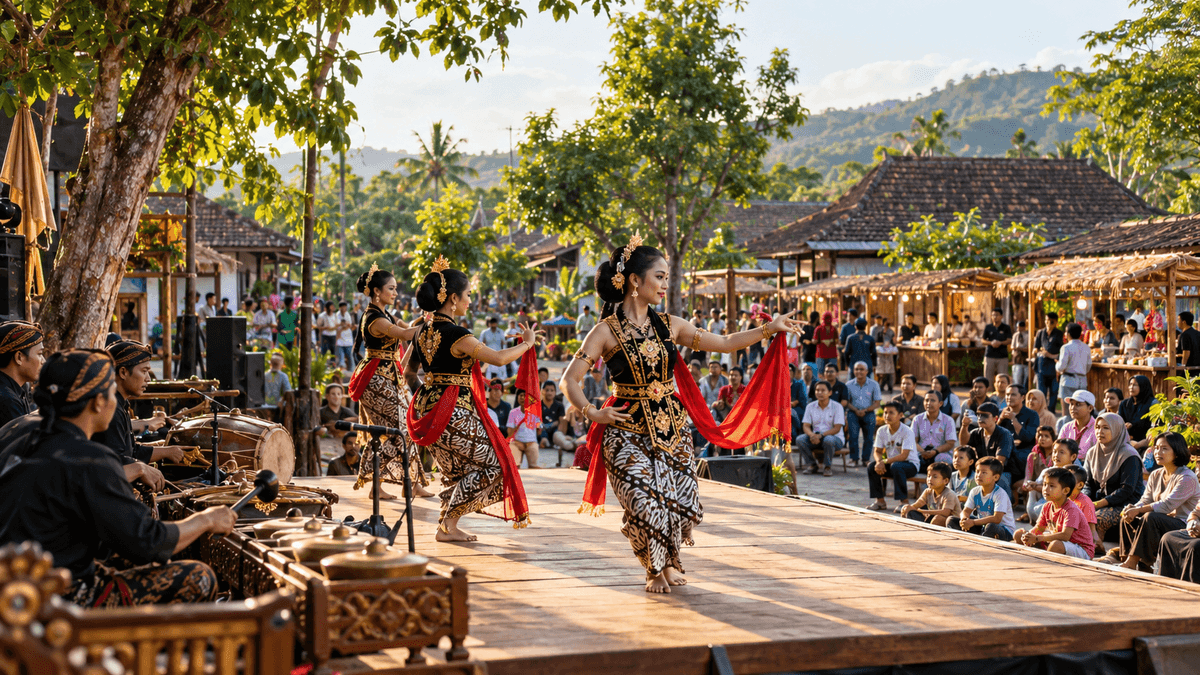
Attendance and local economic value differ
A tourism event can attract crowds, receive media attention, and create a visible market for food, transport, crafts, and accommodation. Those outcomes matter, but they do not answer the central economic question: how much additional value stays with local workers, artists, vendors, and businesses after event costs are paid? Nor do they answer a separate cultural question: who has the authority to decide which practices are shared with visitors and which remain under community control?
Gunungkidul hosts different kinds of events that should not be treated as interchangeable products. In a July 2026 report about a Rasulan event in Padukuhan Pelem, the Gunungkidul Regency Government described the tradition as an annual community practice associated with gratitude for harvests, prayer, and solidarity. That report documents the official framing of one event; it is not a complete account of all local variations or every participant’s perspective. (Gunungkidul Regency Government, “Wabup Joko Parwoto: Rasulan Bukan Sekadar Seremonial, tetapi Wujud Syukur dan Doa Bersama” (opens in a new tab), published July 10, 2026; checked October 26, 2026.)
A different example is the Sedekah Laut or Petik Laut tradition at Sadeng. In its July 7, 2026 report, the Gunungkidul Regency Government described the community program as including a cultural procession, performances, and the sea-offering ritual. The report attributed an estimated funding need of approximately IDR 276 million to event chair Agus Sujoko. It said the stated funding sources included fishermen’s contributions, donations from businesses and traders, sponsors, and support from the Special Fund of the Special Region of Yogyakarta. This is a reported funding requirement, not an audited final expenditure, visitor-spending estimate, net local benefit, or measure of the amount retained by any one group. (Gunungkidul Regency Government, “Harmoni Tradisi dan Syukur, Gemuruh Sedekah Laut di Pesisir Pantai Sadeng” (opens in a new tab), July 7, 2026; checked October 26, 2026.)
Tourism-oriented festivals such as the 2026 Geopark Night Specta and Festival Cokelat in Nglanggeran have a different commercial and promotional structure. The district government reported that the combined events officially opened at the Embung Nglanggeran tourism area on July 10, 2026, as an effort to integrate agriculture, tourism, and the creative economy. That description establishes the event’s stated aims and program, not its realized economic effect; results still require separate measurement. (Gunungkidul Regency Government, “Sinergi Pariwisata dan Pertanian, Geopark Night Specta ke-8 dan Festival Cokelat ke-4 Resmi Dibuka di Nglanggeran” (opens in a new tab), July 10, 2026; checked October 26, 2026.)
Three accounts are needed
Event evaluation should keep three accounts separate.
The event budget records money used to stage the program: venue and equipment, performers, sound and lighting, safety, security, sanitation, waste handling, permits, transport, communications, and ritual-specific requirements. It should distinguish cash expenditure from donated goods, volunteer labor, and in-kind support. Otherwise, the apparent cost may omit real resource use.
The local business account records who receives the payments. It should identify whether vendors, production companies, artists, transport operators, and accommodation businesses are locally owned; how much they are paid; and what proportion of their inputs they buy locally. A contract awarded to a firm based elsewhere may provide a service to the event but produce a different local economic effect from a contract paid to a local enterprise.
The visitor-spending account records additional spending caused by attendance: food, transport, accommodation, retail purchases, and other relevant services. It must distinguish residents from visitors coming from outside the area and account for whether the event was the main reason for the trip or simply one stop in an existing itinerary. Spending by residents who would otherwise have spent money locally may shift from one business to another rather than create an equivalent net gain for the local economy.
These distinctions are important in event economics research. Warnick, Bojanic, and Cartier’s study of tourism-event measurement identifies methodological problems including representative sampling, defining local and nonlocal attendees, and estimating purchases inside versus outside the impact area. The study offers a methodological reminder that an event-impact claim depends on how spending and the study area are defined, and it gives no evidence about Gunungkidul’s particular events. (Warnick, Bojanic, and Cartier, “A Comparison of Economic Impact Measurement Techniques for a Tourism Special Event,” Journal of Travel Research, 2017 (opens in a new tab).)
What the Sadeng funding figure can and cannot tell us
The reported IDR 276 million for Sadeng’s 2026 Sedekah Laut offers a starting point for a transparent event account. It shows that the organizing committee described a mixed funding model involving community contributions, private donations, sponsorship, and public support. It does not provide, on its own, a full breakdown of what was purchased, which organizations received payment, how much was spent locally, or what additional costs were borne by public agencies and residents.
A useful disclosure would present the budget by category and funding source. It would show actual spending against the original estimate, list the main contracts and their locations, describe volunteer and in-kind contributions, and identify public services provided outside the event committee’s budget. Sensitive cultural or personal information should not be disclosed unnecessarily; public accountability can focus on the financial categories and governance arrangements needed to understand the use of funds.
The same principle applies to festival turnover. Gross sales reported by food stalls do not equal profit. Vendor receipts do not reveal ingredient, transport, staffing, or stall-rental costs. A high total can also obscure whether sales were concentrated among a few established businesses or spread across local vendors. To evaluate distribution, organizers need a vendor register, a method for identifying business location and ownership, and a post-event survey of sales and costs.
The public sources reviewed for the cited events do not provide a reconciled event-level account of actual expenditure, local contract recipients, vendor net income, visitor origin, incremental visitor spending, or additional public-service costs. The article therefore sets out an accounting method for these questions rather than claiming a measured local multiplier or net economic impact for the events discussed.
Cultural control is central
Rasulan and Sedekah Laut have meanings that precede their use in tourism promotion. They may involve collective obligations, religious or customary practices, family participation, local leadership, and a shared calendar. A visitor economy should not make the ritual timetable, imagery, or content subordinate to the demands of a tourism campaign. Nor should every element be presented as a performance that outsiders are entitled to watch, photograph, or purchase access to.
Melasti is another example of a religious ceremony documented at the coast of Gunungkidul, including Ngobaran Beach. ANTARA’s photo report documented a Melasti ceremony there on March 9, 2020. That dated record confirms the event at that time, not the current schedule, access policy, or preferences of the community. Any present-day tourism coverage should be checked with the relevant organizers and community representatives rather than assuming that a past event remains open to public observation on the same terms. (ANTARA Foto, “Upacara Melasti di Gunungkidul” (opens in a new tab), March 9, 2020; checked October 26, 2026.)
The correct governance model depends on the event. A ticketed commercial festival can have a formal program, public vendors, paid performers, and a defined sales strategy. A community ritual may have portions that are private, restricted, or governed by local practice. Both can generate economic activity, but the right to set boundaries is not the same. Consultation must occur before promotion and event design, and continue after a campaign has been announced.
Organizers should agree on who can authorize photography, interviews, commercial sponsorship, vendor placement, visitor access, and the use of cultural symbols in merchandise or advertising. Consent should be specific and revocable where appropriate. A community should also have a way to raise concerns or withdraw permission for activities that conflict with the event’s purpose. The goal is to ensure that cultural change is directed by the people who sustain the culture.
A measurement system that event organizers can use
A credible system can be relatively simple, provided the definitions are consistent.
- Before the event: establish a budget, funding sources, list of expected contracts, vendor selection rules, event objectives, cultural protocols, public-service plan, and baseline visitor or business indicators where available.
- During the event: record actual attendance using a stated method, separate performers and staff from attendees, register vendors and suppliers, document contracts and payments, and record public services such as additional traffic control, sanitation, and security.
- After the event: survey a representative sample of attendees about home location, main trip purpose, length of stay, and spending by category. Survey vendors and performers about gross sales or fees, direct costs, and payment timing. Compare actual expenditure with the event budget.
- After a defined interval: check repeat bookings, follow-up orders, new supplier relationships, and whether the event resulted in ongoing sales or jobs. This helps distinguish a short-lived sales spike from a durable business effect.
The report should publish assumptions and limitations. A sample of visitors is not automatically representative. Social-media impressions are not visitor counts. Gross turnover is not profit. And a regional spending estimate should not be presented as the local economic impact if a substantial share of purchases went to outside suppliers or visitors would have visited anyway.
Recommendations: match the accounting to the event type
For community-led rituals, the first output should be a community-approved event charter: who governs the program, which activities are open to visitors, how the event is documented, and how any commercial opportunity is managed. Financial reporting can then track agreed income, costs, and local payments without forcing the ritual to adopt a commercial logic that does not fit its purpose.
For tourism-oriented festivals, the priority is to connect event budgets to vendor and supplier performance. A small set of tracked indicators (local contract share, local vendor participation, net vendor income where collectable, out-of-area visitor spending, public-service cost, and repeat business) will be more useful than a headline attendance figure alone.
For mixed events, such as a festival that combines cultural activity, agriculture, promotion, and entertainment, organizers should report the components separately. That makes it possible to see whether the visitor economy is supporting local producers, whether public spending is being used efficiently, and whether cultural activities remain under appropriate community control.
Conclusion
Tourism events can create income and public value, but the scale and distribution of those benefits cannot be inferred from attendance, publicity, or a funding estimate. Gunungkidul should evaluate each event through separate accounts for expenditure, local business receipts, visitor spending, public-service costs, and cultural governance. Community rituals and commercial festivals require different rules, even when both attract visitors. The strongest event strategy is one that demonstrates where value goes while preserving the authority of the people whose cultural practices make the event meaningful.
Sources consulted
- Pemerintah Kabupaten Gunungkidul, Dinas Komunikasi dan Informatika. “Wabup Joko Parwoto: Rasulan Bukan Sekadar Seremonial, tetapi Wujud Syukur dan Doa Bersama.” Published July 10, 2026. Direct URL: https://gunungkidulkab.go.id/wabup-joko-parwoto-rasulan-bukan-sekadar-seremonial-tetapi-wujud-syukur-dan-doa-bersama/ (opens in a new tab). Checked October 26, 2026. Documents the official description of a Rasulan event at Padukuhan Pelem on July 9, 2026; it is a report on one local event, not a full ethnographic account.
- Pemerintah Kabupaten Gunungkidul, Dinas Komunikasi dan Informatika. “Harmoni Tradisi dan Syukur, Gemuruh Sedekah Laut di Pesisir Pantai Sadeng.” Published July 7, 2026. Direct URL: https://gunungkidulkab.go.id/harmoni-tradisi-dan-syukur-gemuruh-sedekah-laut-di-pesisir-pantai-sadeng/ (opens in a new tab). Checked October 26, 2026. Attributes the approximate IDR 276 million funding need to event chair Agus Sujoko and lists the reported funding sources; it is not a final expenditure audit.
- Pemerintah Kabupaten Gunungkidul, Dinas Komunikasi dan Informatika. “Sinergi Pariwisata dan Pertanian, Geopark Night Specta ke-8 dan Festival Cokelat ke-4 Resmi Dibuka di Nglanggeran.” Published July 10, 2026. Direct URL: https://gunungkidulkab.go.id/sinergi-pariwisata-dan-pertanian-geopark-night-specta-ke-8-dan-festival-cokelat-ke-4-resmi-dibuka-di-nglanggeran/ (opens in a new tab). Checked October 26, 2026. Documents the event’s opening and stated agriculture-tourism-creative-economy aims, not its net economic impact.
- ANTARA Foto. “Upacara Melasti di Gunungkidul.” Published March 9, 2020. Direct URL: https://www.antarafoto.com/id/view/1152198/upacara-melasti-di-gunungkidul (opens in a new tab). Checked October 26, 2026. Historical documentation of a Melasti ceremony at Ngobaran; it does not establish current schedules or access permissions.
- Warnick, Rodney B., David C. Bojanic, and Elizabeth Cartier. “A Comparison of Economic Impact Measurement Techniques for a Tourism Special Event.” Journal of Travel Research, 56(5), 578-592, 2017. Direct URL: https://journals.sagepub.com/doi/abs/10.1177/0047287516643412 (opens in a new tab). Checked October 26, 2026. The accessible abstract identifies sampling, local/nonlocal definitions, and spending inside versus outside an impact area as methodological issues; the paper provides methods, not empirical results for Gunungkidul.
Keep reading
Related articles: