Can Local Cuisine Become a Reason to Stay Longer in Gunungkidul?
Gunungkidul's traditional dishes could become more than incidental meal stops or souvenirs. The business question is whether credible culinary experiences can change travel choices, raise local food spending, and reward the people who preserve and prepare the food.
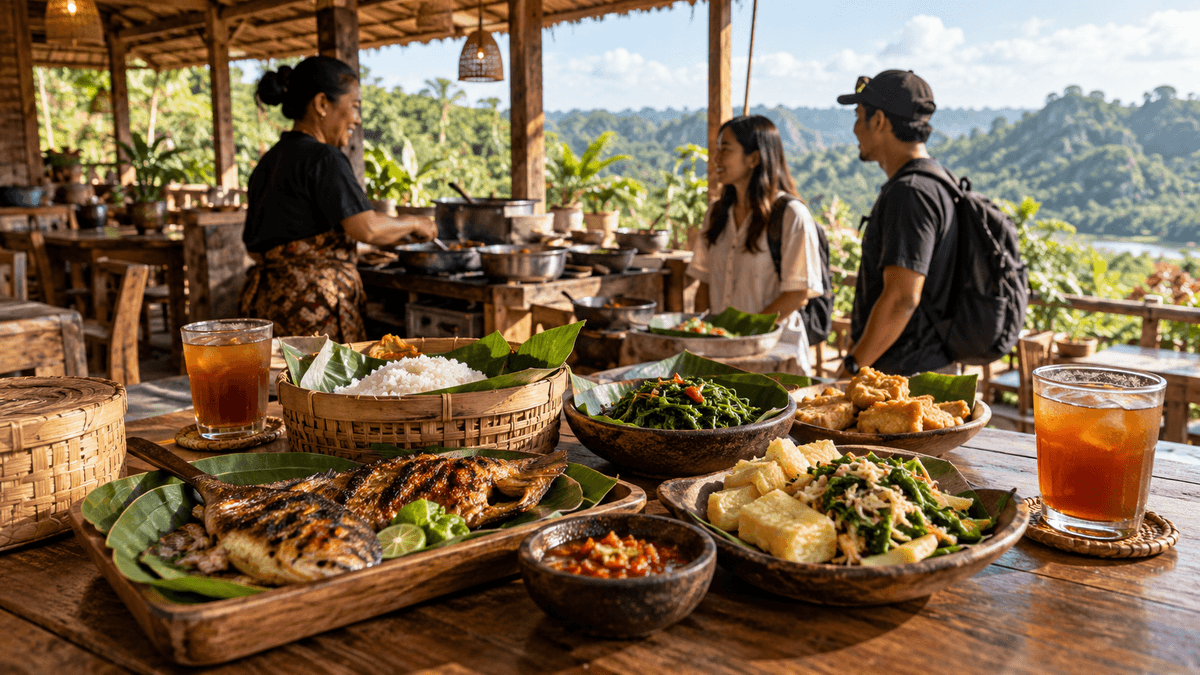
Food matters if it changes a travel decision
Traditional cuisine can be part of a destination's identity without becoming a reason to visit. A visitor may eat thiwul (cassava-based food), gathot (a traditional cassava preparation), pathilo (a cassava-based snack), or a meal of red rice, green-chili vegetables, and meat as a convenient stop during a beach trip. That is local consumption, but it is not yet proof of a culinary tourism market.
Gunungkidul's Tourism Office lists a range of regional foods, including fried grasshoppers, kicikan, pathilo, red rice meals, gathot, and thiwul. This official list establishes that local cuisine is part of the destination's public identity; it does not establish how much visitors spend on these products or whether food influences their choice of itinerary. (Gunungkidul Tourism Office, “Kuliner,” undated page; checked October 26, 2026 (opens in a new tab)).
A 2024 study of traditional culinary ecotourism in Semanu, Gunungkidul, offers a more specific signal. Its repository abstract says the researchers used observation, interviews, and questionnaires; inventoried 25 traditional culinary resources; and identified 12 leading products based on tourists' perceptions of price, taste, appearance, and satisfaction. The abstract reports high interest in traditional cuisine but very low consumption frequency. That finding points to a possible conversion problem: expressed interest may not turn into frequent purchases. The publicly accessible abstract does not establish why that gap exists, and the results are specific to Semanu and the study's method. They are not a regency-wide estimate of demand. (Kristianti, Resmayasari, and Patabang, Pengembangan Ekowisata Kuliner Tradisional di Kecamatan Semanu, Kabupaten Gunungkidul, Provinsi Daerah Istimewa Yogyakarta [Developing Traditional Culinary Ecotourism in Semanu District, Gunungkidul Regency, Special Region of Yogyakarta], IPB University Repository, 2024 (opens in a new tab)).
The strategic question is therefore practical: can food become a planned part of the visitor experience rather than an incidental purchase? To answer that, operators need to test a product, price it correctly, ensure consistent delivery, and measure whether the offer affects bookings and spending. The result should be measured, not assumed.
Turn individual dishes into a product visitors can plan around
A list of dishes is useful as an inventory, but a list by itself is not a bookable experience. A culinary product needs a reason to choose it, a clear format, dependable operating hours, transparent prices, and a way to fit into a trip.
One model is a signature-meal stop built around a small number of dishes with a clear local identity. It should explain the food accurately, identify the serving size, list its price, and state when it is available. The purpose is to reduce uncertainty for visitors who want to try local food but do not know where, when, or how to order it.
A second model is a short culinary route involving several independent businesses. It could include a main meal, a traditional snack, and an item to take home. The route should be designed around confirmed opening days, travel logistics, portion sizes, and enough time at each stop. Businesses should agree in advance on booking procedures, how referrals are recorded, and how any package payment is divided. A route should not be promoted as bookable until those operating details are confirmed.
A third model is a food-and-story session in which a cook or producer explains the ingredients, preparation, and social context of a dish. The value lies in the explanation and participation, not in presenting local people as props or turning private household knowledge into a public performance without consent. Any demonstration must be paid and scheduled as real work, and the host should retain control over what is shared.
A fourth model is culinary take-home retail: food that can be safely packaged, transported, and stored for an appropriate period. This may capture spending from visitors who do not have time for a long meal. Shelf life, storage conditions, packaging cost, and product consistency must be established before the product is sold as a reliable souvenir.
These formats are options to test, not a claim that every one is already offered in Gunungkidul. The first step is to inventory existing products and businesses, then select a manageable pilot with operators who actually want to participate. Before calling a pilot successful, compare its sales and bookings with a defined baseline and account for substitution: spending on the new product may replace spending that would otherwise have gone to another local meal rather than create additional local value.
Food can support a longer itinerary when the timing works
A culinary stop changes a travel plan only when it provides enough value to influence the visitor's decision. An experience that takes two hours, runs only at a particular time, or requires a reservation may be meaningful to a traveler who has planned for it. The same offer may be irrelevant to a visitor rushing between beaches.
The route therefore matters as much as the dish. A food-led product needs a defined place in a trip: a morning tasting before an attraction, a booked lunch after an activity, or a planned evening meal near accommodation. The product's value will depend on access, opening hours, wait times, service reliability, and how easily visitors can find the business. These details should be checked with each provider rather than inferred from a map listing.
Food-tourism studies support treating taste, local-food appeal, cultural experience, and social interaction as possible travel motivations. One study based on 335 valid responses recruited through online networks of food enthusiasts identified taste, socialization, cultural experience, traditional-food appeal, and local-destination appeal among reported food-travel motivation factors. Its sample was not designed to represent ordinary Gunungkidul visitors, so it cannot establish how many local visitors would travel specifically for food. The publisher’s full page could not be opened during this check; the study is used only as supplementary conceptual context, not as evidence of Gunungkidul-specific demand. (Su, Johnson, and O'Mahony, “Analysis of Push and Pull Factors in Food Travel Motivation,” Current Issues in Tourism, 2020 (opens in a new tab)).
For Gunungkidul, a defensible approach is to frame cuisine-led travel as a hypothesis and test it. Ask people whether a dish or food experience affected their decision to add a stop, extend the trip, or book accommodation. Compare the behavior of customers who booked the culinary product with similar visitors who did not. Record actual transactions rather than relying only on stated interest.
This article does not repeat a district-wide argument about average length of stay. Its narrower focus is whether a specific culinary offer changes the itinerary and sales performance of the businesses delivering it.
Quality and margin determine whether the product can last
Culinary identity cannot compensate for unreliable service. A product that appears attractive online but is unavailable on the advertised day can damage trust. Inconsistent portion sizes, unpredictable waiting times, unclear prices, poor packaging, or weak food-handling routines can make a one-time curiosity difficult to convert into repeat demand.
Operators should define a minimum service specification proportionate to the product: opening days, booking lead time, menu and portion information, ingredient availability, preparation time, handling and storage procedures, complaint response, and refund rules. Where a product requires advance preparation, the operator should set a booking cutoff rather than accept orders that cannot be fulfilled.
The financial side also requires discipline. The price of a dish is not the same as the income retained by the cook or producer. Costs may include ingredients, preparation labor, fuel, utilities, rent, packaging, spoilage, transport, payment fees, commissions, and the time spent explaining the product to visitors. A bundled culinary route may increase order volume but can also add coordination costs and reduce the margin of participating businesses if the package price is set too low.
Before launching a package, calculate the contribution margin for each component. Define which business collects payment, when other businesses are paid, how cancellations are handled, and who bears the loss if a participant does not arrive. If one operator acts as the booking agent, its commission and responsibilities should be disclosed to the participants.
Food safety should be built into the offer rather than added after marketing begins. Operators need suitable handling and storage practices, accurate ingredient information, and procedures for dealing with food that cannot be safely served. Any applicable local requirements or certifications should be checked with the responsible authority before a product is launched. An editorial article should not imply that a business meets these requirements unless the status has been verified.
Measure whether culinary tourism creates additional value
A pilot should start with a baseline. The objective is to determine whether the product generates additional, sustainable activity for the participating businesses, beyond a count of people who try a dish.
Useful indicators include:
- Conversion: the share of inquiries that become bookings and the share of visitors who purchase the product.
- Trip behavior: the proportion who add a culinary stop, change a route, or book an overnight stay because of the offer.
- Business performance: sales, average transaction value, contribution margin, cancellations, repeat orders, and purchases per participating business.
- Local value: payments to local cooks, producers, workers, and participating businesses after incremental costs are deducted.
- Reliability: on-time service, product availability, food-quality complaints, refunds, and repeat bookings.
A short pilot can compare sales during product operation with a similar set of days or businesses, but comparisons must account for holidays, seasonality, price changes, and other promotions. A rise in sales during a festival cannot automatically be attributed to the food product if other attractions and marketing activities changed simultaneously.
The first pilot should be limited enough to manage: a small group of willing businesses, a documented product, confirmed hours, transparent prices, and a simple way to record bookings and sales. Expand only when the evidence shows that customers buy the product and the businesses can deliver it without harming normal operations.
The opportunity is a better product
Gunungkidul already has recognizable food traditions. The missing step may be the conversion of that identity into a dependable product that visitors can find, understand, book, and recommend. The Semanu study's reported combination of strong interest and low consumption frequency makes this worth testing, but it does not prove demand will grow on its own.
A practical strategy is to select a few distinctive non-seafood culinary offers, work with established local providers, and test whether clearer product design changes visitor behavior and business performance. The result should be judged by paid demand, service quality, and net value retained by participating businesses, not by the number of promotional posts or dishes listed on a destination page.
Sources consulted
- Gunungkidul Tourism, Creative Economy, Youth and Sports Office. “Kuliner” [Culinary Foods]. Undated official culinary listing. Checked October 26, 2026. https://wisata.gunungkidulkab.go.id/kuliner/ (opens in a new tab)
- Kristianti, Hana; Resmayasari, Ira; and Patabang, Melewanto. Pengembangan Ekowisata Kuliner Tradisional di Kecamatan Semanu, Kabupaten Gunungkidul, Provinsi Daerah Istimewa Yogyakarta. IPB University Repository, 2024. Checked October 26, 2026. https://repository.ipb.ac.id/handle/123456789/155167 (opens in a new tab)
- Su, Diep Ngoc; Johnson, Lester W.; and O'Mahony, Barry. “Analysis of Push and Pull Factors in Food Travel Motivation.” Current Issues in Tourism, 23(5), 572-586, 2020. The publisher's accessible abstract describes 335 valid responses recruited through online networks of food enthusiasts; the sample is not representative of all visitors to Gunungkidul. Checked October 26, 2026. https://doi.org/10.1080/13683500.2018.1553152 (opens in a new tab)
Keep reading
Related articles: