Tourism Investors, Government, and Residents Need a Clear Social Contract
A tourism project needs more than permits and a promotional promise. A clear local compact can define public commitments, community concerns, supplier opportunities, environmental duties, monitoring, and dispute resolution.
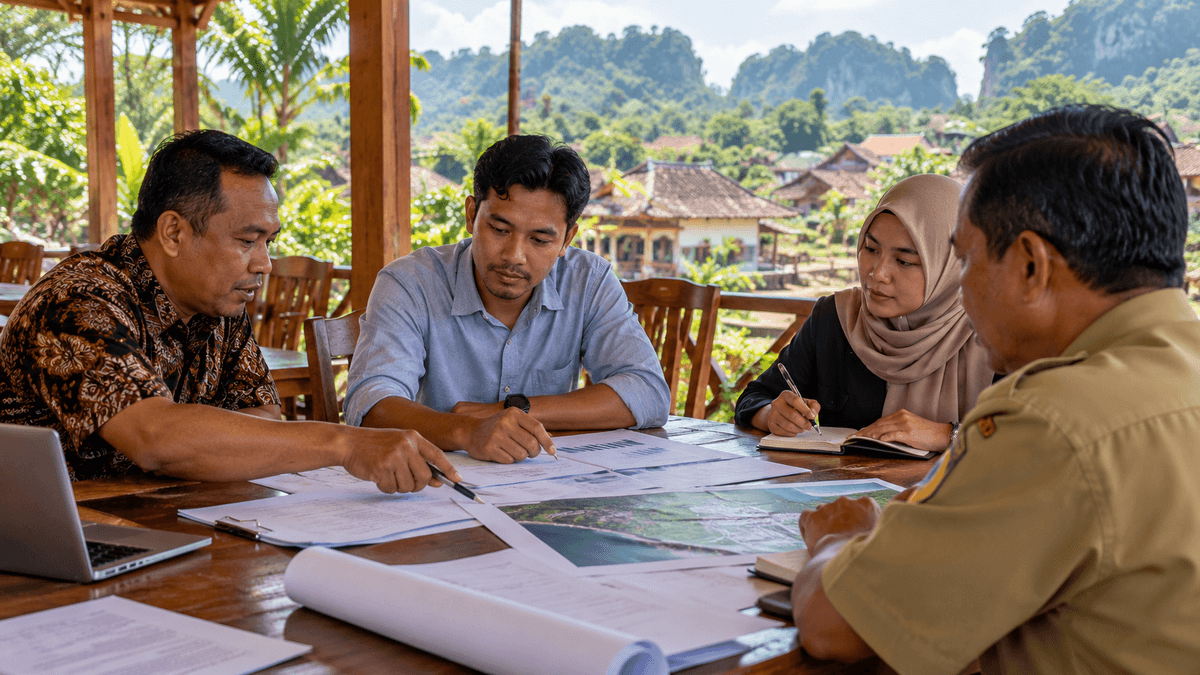
A permit establishes legal authorization under the applicable rules. A public meeting records a form of participation. Neither, by itself, guarantees that a tourism project will deliver local benefits, manage environmental risks, or respond fairly when problems arise.
Gunungkidul can strengthen destination governance by making the commitments between investors, government, and affected communities clearer. The phrase “social contract” here means a transparent set of public-interest expectations, responsibilities, monitoring arrangements, and ways to resolve concerns. It is not a substitute for formal permits, statutory duties, procurement rules, or legally enforceable agreements.
Why a shared framework is needed
Tourism development involves multiple groups. Investors need a predictable operating environment and clarity about obligations. Government needs investment that fits spatial planning, creates economic activity, and does not create unmanageable public costs. Residents may want jobs and business opportunities while also protecting water access, public space, cultural practices, safety, and the environment.
These interests can overlap, but they are not identical. One group may benefit from higher visitor numbers while another experiences congestion, waste, noise, limited access, or pressure on water. A project may create jobs but leave local firms unable to compete for procurement. A community meeting may be held even when some participants lack information, time, confidence, or influence.
Research in Gunungkidul shows why participation should not be treated as a synonym for harmony. A 2025 study of community-based tourism in Bejiharjo describes a locally initiated process developed through sustained engagement and interviews over 2022-2024. By contrast, a 2026 ethnographic study of Putat Tourism Village examines how implicit conflicts and unequal power can persist inside a model often associated with participation and harmony. These cases are not proof that every destination has the same conditions. Together, they show that governance design and everyday power relations matter. Bejiharjo study (opens in a new tab); Putat study (opens in a new tab).
Start before the project becomes difficult to change
Dialogue is most useful before decisions become expensive to reverse. At the earliest stage, investors and government should explain the project’s activity, scale, site, timeline, proposed access, demand assumptions, basic service needs, relevant approval steps, and known uncertainties. This information can be presented in a plain-language summary while respecting legitimate confidentiality and personal-data protections.
Consultation should then identify the people likely to be affected, including people other than formal leaders or those who can attend daytime meetings. Groups may include households near access routes, workers, vendors, suppliers, farmers, fishers, community organizations, nearby businesses, and people who use local resources without earning tourism income. Who is relevant depends on the project and place; participation should not become a generic attendance list.
The process should make clear which decisions are open for input, which are governed by legal requirements, who has decision-making authority, and how responses will be recorded. This prevents a meeting from being mistaken for permission to bypass licensing or environmental assessment.
Put commitments into a responsibility matrix
A practical project compact can set out several categories of commitments. Each must be assigned to a responsible party, a timeline, and a way to verify completion.
| Commitment area | Examples of useful commitments | Evidence of delivery |
|---|---|---|
| Local employment | Publish job profiles, skills requirements, training access, and recruitment timelines | Jobs filled, contract duration, training-to-employment results, wage and hours information in aggregate |
| Local procurement | Map suitable product categories, supplier criteria, payment terms, and trial orders | Procurement value by supplier location, repeat orders, payment time, supplier retention |
| Environmental management | Identify relevant approval conditions, monitoring, mitigation, restoration, and incident reporting | Published compliance summaries, monitoring results, corrective actions, independent checks where appropriate |
| Shared infrastructure | Identify access, water, drainage, sanitation, waste, and emergency-service responsibilities | Asset and maintenance plan, operating budget, performance indicators, complaint response |
| Public access and livelihoods | Explain access arrangements, safety rules, construction disruptions, and effects on existing users | Accessible maps or notices, documented resolutions, compliance with applicable rights and rules |
| Grievances | Provide a clear channel, response deadline, escalation route, and protection against retaliation | Number and type of complaints, response time, resolution status, repeated issues |
These indicators should be tailored to the project rather than inserted as boilerplate. A promise to hire “local people” is vague unless local eligibility, job types, hiring timelines, training, and measurement are defined. A commitment to support MSMEs is weak unless it describes an actual procurement or capability-development pathway.
Voluntary benefits and legal obligations differ
A project compact should clearly separate what a party is legally required to do from what it voluntarily commits to provide. Environmental approvals and business licenses are governed by law, including the relevant risk-based licensing framework under Government Regulation No. 28 of 2025 and the environmental-protection framework under Government Regulation No. 22 of 2021. PP No. 28/2025 (opens in a new tab); PP No. 22/2021 (opens in a new tab).
Likewise, local hiring, training, public infrastructure contributions, or community programs should not be described as substitutes for complying with applicable permits, labor rules, tax and retribution obligations, or environmental duties. Any agreement must be checked for legal authority, consistency with public budgeting and procurement rules, and enforceability. The name “social contract” does not itself create a legal instrument or binding obligation.
Make public agencies answerable for their role
Residents should not be expected to negotiate every public-service issue directly with an investor. Government remains responsible for its own statutory functions, including the relevant planning, licensing, service delivery, public safety, monitoring, and enforcement duties. The compact should identify the agency responsible for each public matter, what information it will provide, and the channel available to raise concerns.
This matters when a problem crosses institutional boundaries. A visitor-area waste issue may involve the operator, municipal services, a village government, and environmental oversight. If no one is clearly responsible, the issue can remain unresolved while each party points to another. A responsibility matrix and a common reporting process can help avoid that outcome, provided they do not blur the legal authority of each institution.
Build an effective grievance mechanism
A grievance channel should be accessible to people who do not have legal counsel or strong institutional connections. It can include a simple written or digital reporting route, an offline option for people with limited internet access, a reference number, a clear explanation of the process, and a way to escalate an unanswered complaint.
The mechanism should distinguish urgent risks, such as immediate safety concerns, from routine requests for information or disputes about long-term impacts. It should also protect personal information, avoid retaliation, and explain when a complaint must be referred to a competent authority rather than handled privately by the operator.
Publishing grievance statistics can improve accountability, but raw complaint counts are not enough. A low number may mean few problems, limited access, or a lack of trust. Better reporting includes response time, resolution status, repeat issues, and whether corrective actions changed the underlying practice. Where the matter involves potential legal violations, the appropriate official process should remain available.
Monitor results after the opening ceremony
Commitments should be revisited during construction, the first operating year, and later review periods set by the project’s scale and risk. The public report can compare promised and actual jobs, procurement, infrastructure service, environmental monitoring, and complaint outcomes. If a target was missed, the report should explain why, identify corrective action, and state the next review date.
Reporting should be proportionate. A small enterprise does not need the same disclosure system as a large development with major infrastructure and environmental implications. But every project should be able to explain its material impacts and demonstrate compliance with obligations that apply to it.
The process must also allow new facts to change decisions. If monitoring reveals that a water source is under pressure, visitor access creates a safety problem, or a supplier program is not reaching local firms, the response may require new operating measures. A compact that cannot adapt becomes public relations rather than governance.
A compact is useful only when it changes behavior
Gunungkidul should not measure community participation simply by the number of meetings held or signatures collected. It should ask whether affected groups received usable information, whether material concerns received reasoned responses, whether commitments have owners and budgets, and whether results can be independently checked.
A well-designed social compact can reduce misunderstandings and make local benefits more concrete. It cannot guarantee agreement on every project, erase competing interests, or excuse violations of law. Its value is to make the obligations, trade-offs, evidence, and procedures visible before a dispute becomes entrenched.
The central test is simple: after a project begins operating, can residents identify what was promised, who is responsible, what evidence shows progress, and where to go when a commitment or legal obligation is not met? If the answer is yes, the relationship between investment and the local community is more accountable than a process built on promotional statements and informal assurances.
Sources consulted
- Humaniora, Universitas Gadjah Mada journal platform. “Community Initiative and Harmonizing: Key Strategies in Community-Based Tourism Development in Bejiharjo, Gunungkidul (opens in a new tab).” Published/dated: 2025. Accessed: 25 October 2026.
- Journal of Social Development Studies, Universitas Gadjah Mada journal platform. “Reproduksi Konflik Implisit dalam Bias Kuasa Pariwisata di Desa Wisata Putat, Gunungkidul (opens in a new tab).” Published/dated: 2026. Accessed: 25 October 2026.
- BPK RI, Database Peraturan. “Peraturan Pemerintah Nomor 28 Tahun 2025 tentang Penyelenggaraan Perizinan Berusaha Berbasis Risiko (opens in a new tab).” Published/dated: 5 June 2025. Accessed: 25 October 2026.
- BPK RI, Database Peraturan. “Peraturan Pemerintah Nomor 22 Tahun 2021 tentang Penyelenggaraan Perlindungan dan Pengelolaan Lingkungan Hidup (opens in a new tab).” Published/dated: 2 February 2021. Accessed: 25 October 2026.
- JDIH Kementerian Keuangan. “Undang-Undang Republik Indonesia Nomor 10 Tahun 2009 tentang Kepariwisataan (opens in a new tab).” Published/dated: 2009; access checked 25 October 2026. Accessed: 25 October 2026.
- Karnadjaja et al., Public Policy and Administration Research. “Study of Tourism Governance in Gunungkidul (An Initiative Proposing Guidelines for Beaching Tourism Governance) (opens in a new tab).” Published/dated: 30 November 2020. Accessed: 25 October 2026.
Keep reading
This article is part 5 of 11 in the series "Investment, Policy and the Next Decade".
- Previous: Can Tourism Fees Help Fund Conservation in Gunungkidul?
- Start of the series: Tourism Investment Must Deliver More Than a Headline Figure
Related articles: