Who Should Pay for Conservation in Gunungkidul?
Karst and coastal conservation create public benefits, while the costs of protection can fall unevenly on residents, businesses, visitors, and government. A fair financing model must connect responsibility, ability to pay, and measurable outcomes.
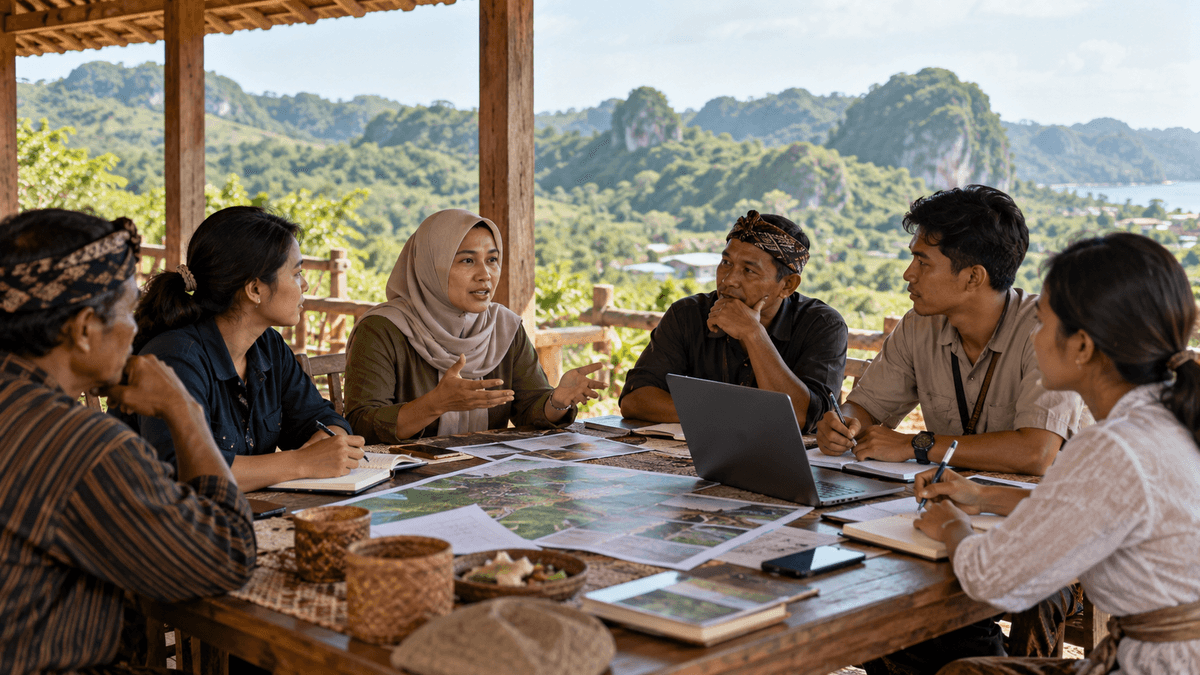
Conservation has costs, and so does failing to conserve
Protecting Gunungkidul's karst and coast requires money, staff, monitoring, waste services, infrastructure maintenance, and decisions about how land can be used. Those costs do not fall automatically on the people and businesses that benefit most from a healthy landscape. A household may live with a land-use restriction, a small vendor may depend on access to a beach, a tourism operator may earn revenue from the destination, and a public agency may be responsible for services shared by residents and visitors.
This creates a question of environmental justice: who benefits from protection, who pays for it, and who has a voice in deciding what the money will support? Conservation is not cost-free. But neither is environmental degradation, which can reduce water security, damage public assets, weaken local livelihoods, or diminish the ecological qualities that tourism depends on.
A fair policy should avoid two extremes: making local households pay the full price for a public environmental benefit, and allowing businesses to profit from sensitive landscapes while shifting avoidable environmental costs to the public.
What is already in the planning framework?
Gunungkidul's Regional Regulation No. 1 of 2025 establishes a Regional Environmental Protection and Management Plan for 2025-2055. The official record places environmental carrying capacity, environmental problems and targets, and management directions within the plan's scope. The regulation is a long-term planning framework, not a guarantee that every conservation measure has been funded or implemented. See the official record of Regional Regulation No. 1 of 2025 (opens in a new tab).
UNESCO's Global Geopark framework also provides a relevant principle. Geoparks combine protection, education, and sustainable development and are expected to involve local communities in a bottom-up approach. Geological heritage is not meant to be separated from the natural, cultural, and economic life of the area. See UNESCO's description of Global Geoparks (opens in a new tab).
Together, these frameworks support a policy question rather than a ready-made financing answer: what combination of public funding, operator responsibility, visitor contributions, and community participation can finance the required work without unfairly burdening the people least able to pay?
Match the payer to the responsibility
A practical model begins by separating different kinds of conservation expenditure.
First, public environmental services. Core services such as planning, baseline data, inspection, public access management, community information, emergency coordination, and landscape-scale monitoring often benefit residents and visitors alike. Public budgets are a logical source because these functions serve broader public interests. Their funding should be transparent and tied to measurable work rather than vague promises of sustainability.
Second, project-specific prevention and mitigation. A developer or operator should fund measures needed to manage the impacts of its own activity, as required by the approvals and obligations applicable to the project. Examples may include drainage, wastewater treatment, safe site design, waste handling, or restoration where required. These measures should not be treated as optional donations or replaced by general publicity about corporate social responsibility.
Third, visitor-related services. Where lawful and proportionate, visitor contributions may support cleaning, interpretation, facilities, safety, or conservation work associated with destination use. The exact instrument (entry fee, service charge, tax, retribution, or another arrangement) must comply with applicable Indonesian rules and local authority. Money collected for one purpose should not be described as dedicated conservation funding unless the budget and legal arrangements actually establish that link.
Fourth, voluntary and external funding. Research grants, philanthropy, partnerships, and responsible business contributions can complement core budgets. They are useful for pilots and specialized work, but they are often time-limited and should not be the sole source for essential recurring services such as wastewater maintenance or routine monitoring.
Why “the tourist should pay” falls short
A visitor fee can sound simple, but its effects depend on design. A flat charge may be affordable for some visitors while disproportionately affecting local residents, low-income households, school groups, or workers who need to enter the area. A charge can also be ineffective if the main environmental problem comes from an operator's wastewater, unrelated land clearing, or weak public-service capacity rather than visitor volume alone.
Before adopting a conservation contribution, decision-makers should answer several questions: What legally authorized service or public purpose does it finance? Who collects it? Is it included in an existing charge or added to it? Who is exempt? How are funds budgeted and audited? How will the public know what was purchased and whether conditions improved?
Revenue should not be the only performance measure. A fee that raises money but leaves the underlying problem unresolved is not a successful conservation intervention. The outcome might be reduced litter, safer visitor access, better wastewater compliance, restored vegetation, more reliable monitoring, or another site-specific result. Those outcomes need a baseline and a reporting method.
Design funding around the actual risk
Conservation budgets should begin with the site's needs, not the assumption that every location requires the same intervention. A karst catchment may need groundwater monitoring and waste controls. A heavily used beach may need sanitation, litter collection, erosion monitoring, and emergency access. A sensitive cave may require visitor routing, limits on physical disturbance, specialist monitoring, or periods of rest. A rural landscape may need community-led restoration and long-term land stewardship.
For each priority, the responsible authority or manager should publish:
- The environmental issue and evidence supporting the intervention.
- The work to be funded, including operating and maintenance costs.
- The payer or funding source and the legal basis for any mandatory charge.
- The people who may bear costs or face restrictions, and what consultation took place.
- The expected result, baseline, indicator, and reporting schedule.
- The response if the measure fails or the condition worsens.
This framework also helps distinguish one-time construction from recurring costs. A new waste facility can be funded through a capital project, but it still requires staff, transport, repairs, and a reliable destination for collected material. A water-quality test can be paid for once, but understanding seasonal trends needs repeated sampling.
Protect the people who bear restrictions
Environmental protection can impose concentrated costs on particular communities, even when benefits are widely shared. Restrictions on access, construction, harvesting, boating, vending, or other activities may affect livelihoods and established uses. Whether a restriction is necessary depends on evidence and law, but its distributional effects must still be analyzed.
A fair transition can include advance notice, transparent criteria, practical alternatives, training where it addresses a real market need, support for changing operating practices, and compensation only where a lawful and applicable mechanism exists. These measures should not be sold as automatic entitlements where no legal basis has been confirmed. They should be considered as policy tools whose eligibility, financing, and effectiveness need clear rules.
Participation also requires more than inviting residents to a meeting after the key decision has already been made. Communities need relevant information early enough to influence alternatives, conditions, monitoring, and how benefits are shared. Their feedback should be recorded, answered, and linked to decisions.
Keep the money and results auditable
A conservation-finance dashboard should link inputs to activities and outcomes. It might report annual funds allocated and spent, procurement, maintenance completion, monitoring coverage, waste removed and properly handled, water-quality trends, restored area, compliance findings, and complaints resolved. Where tourism revenue or charges contribute to the budget, the public should be able to follow the connection between collection, lawful allocation, expenditure, and result.
No single indicator can prove that an ecosystem is healthy. For example, hectares replanted do not demonstrate that the right species survived or that habitat function returned. Spending more does not automatically mean better conservation. Indicators should be chosen with technical expertise and interpreted against a baseline.
The bottom line
Conservation in Gunungkidul should be financed through a transparent mix of public funding for shared public functions, project-specific responsibility for avoidable impacts, and carefully designed visitor or business contributions where legally appropriate. The cost should not be pushed by default onto local households, and the benefits should not remain an abstract promise. Every major funding stream needs a stated purpose, a public accounting trail, and measurable environmental and social outcomes.
Sources consulted
- Government of Gunungkidul. Regional Regulation No. 1 of 2025 on the Regional Environmental Protection and Management Plan for 2025-2055. Enacted 15 July 2025; checked 25 October 2026. https://peraturan.bpk.go.id/Details/330388 (opens in a new tab)
- UNESCO. “UNESCO Global Geoparks.” Page updated 20 August 2026; checked 25 October 2026. https://www.unesco.org/en/iggp/geoparks/about (opens in a new tab)
- Government of Indonesia. Government Regulation No. 22 of 2021 on Environmental Protection and Management. Enacted 2 February 2021; checked 25 October 2026. https://peraturan.bpk.go.id/Details/161852/pp-no-22-tahun-2021 (opens in a new tab)
Keep reading
This article is part 5 of 12 in the series "Conservation, Environment and the Tourism Trade-off".
- Previous: How to Measure the Ecological Cost of Tourism Development
- Start of the series: Gunung Sewu Karst: The Ecological Foundation of Tourism
Related articles: