Designing Multi-Day Tourism Routes in Gunungkidul
Gunungkidul has the ingredients for multi-stop trips, but a list of attractions is not yet a bookable tourism product. This analysis explains the coordination, pricing, and measurement needed to turn separate sites into reliable routes.
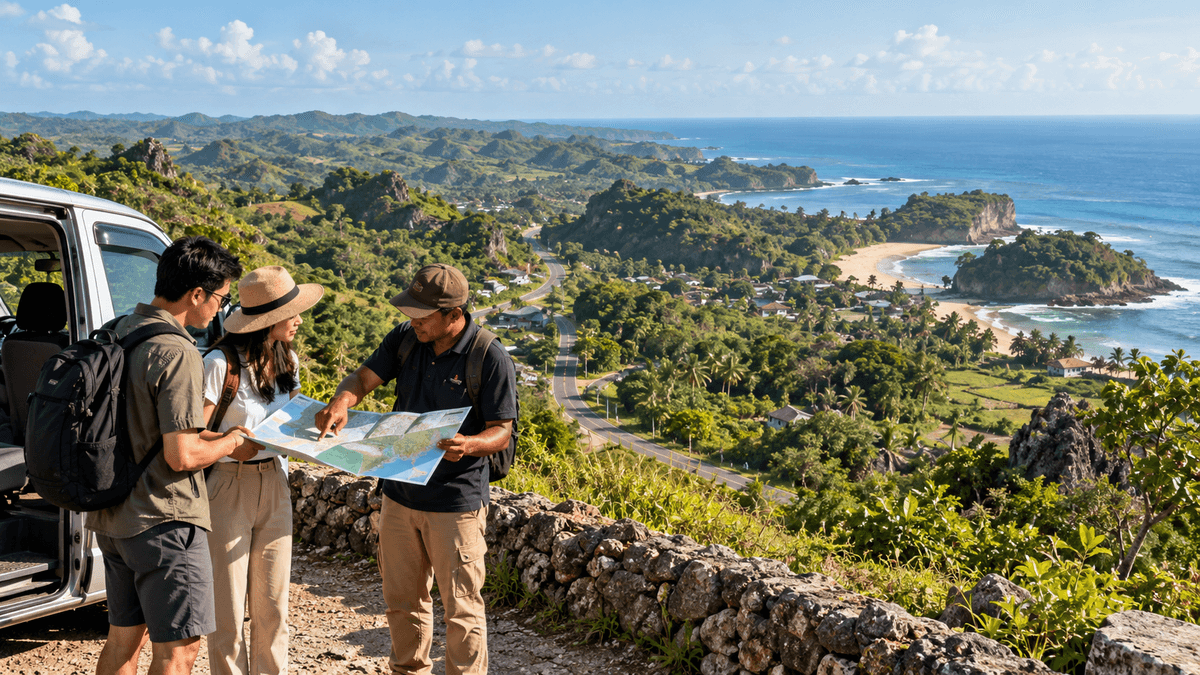
A route is more than a list of destinations
A destination list helps travelers decide where to go. A tourism route must solve a harder problem: how to connect different places, operators, transport services, meals, and overnight stays into one dependable product that people can understand, book, and complete.
This distinction matters for Gunungkidul Regency in the Special Region of Yogyakarta. The area offers coastal attractions, cave-based activities, village experiences, food, crafts, and outdoor recreation. Yet the existence of several attractions within the same broad region does not automatically create a coherent two- or three-day trip. Travelers still need to work out travel times, booking contacts, activity availability, meal stops, payment arrangements, and what happens when weather or operating conditions disrupt the plan.
The economic question is therefore whether tourism businesses and destination managers can coordinate those destinations into a product that is commercially viable, operationally realistic, and designed to generate transactions across multiple local businesses. Placing more destinations on an itinerary does not answer it.
Gunungkidul has tested multi-stop concepts on promotional trips
The Gunungkidul Tourism Office has documented familiarization trips that combined multiple types of experience. A July 2023 program, for example, included Kalisuci cave tubing, seafood near Pantai Ngandong, a jeep trip to Timang, sunset at Krakal, an overnight stay around Drini, and village-based activities the following day. The sequence demonstrates that coastal recreation, adventure, food, accommodation, and village experiences can be assembled into a multi-day itinerary. The program was promotional, however; it does not establish current availability, commercial demand, price acceptance, or the amount of spending retained locally. Source: Gunungkidul Tourism Office, 18 July 2023 (opens in a new tab).
A separate July 2024 familiarization trip combined village tourism experiences, such as vegetable harvesting, traditional archery, and candle-making, with coastal destinations. The activity involved travel-industry participants from the Solo area. Again, it provides a useful example of product components. It is no proof that a standardized route is already available to ordinary visitors or that it has delivered measurable economic outcomes. Source: Gunungkidul Tourism Office, “Kegiatan Promosi Wisata Gunungkidul Berkonsep FAM TRIP,” published 19 July 2024 (opens in a new tab).
These examples suggest a design opportunity. They do not justify assuming that every attraction is open, bookable, suitable for every group, or able to handle regular commercial demand. Each component must be verified before a route is sold.
The route product needs a defined customer and a clear promise
The first design decision is the customer problem the product will solve, before the map. A family with young children, a school group, an adventure-oriented group, and a couple seeking a short coastal break have different tolerances for driving time, physical effort, price, and schedule changes.
A route should therefore specify:
- Target segment: who the package is designed for, including group size, mobility needs, age range, and interests.
- Duration and pace: realistic travel and activity blocks, meal periods, rest time, and overnight arrangements.
- Included and excluded services: entrance fees, guides, transport, meals, equipment, insurance where applicable, and accommodation.
- Booking and payment: one point of contact or a clearly explained multi-operator process, deposit rules, cancellation terms, and receipts.
- Operating limits: weather dependencies, minimum group size, activity restrictions, safety requirements, and alternatives if a stop cannot operate.
A two-day sample route might combine a coastal activity, a meal featuring local seafood, an overnight stay, and a village-based experience the following morning. This is a product-design example. It does not claim that those components can currently be booked together as a single package. The specific sites, operators, rates, road conditions, and schedules need direct confirmation before publication or sale.
Coordination is the hidden operating cost
A route that connects several independent operators introduces coordination work that a single-site visit may not require. Someone must confirm availability, synchronize schedules, explain changes to the traveler, reconcile payments, settle supplier invoices, and handle complaints when a component fails.
The route organizer could be a licensed travel business, a destination management group, a cooperative, or another appropriately authorized entity. The right arrangement depends on the services offered and the applicable licensing requirements. What matters operationally is that responsibilities are explicit. A package should name who accepts the booking, who confirms each supplier, who is responsible for transport and safety, who issues refunds, and who makes decisions when weather forces a change.
Informal cooperation can be useful during product development, but verbal understandings are fragile when the volume of bookings increases. Written partner terms should define prices, payment deadlines, minimum bookings, service standards, guest data handling, cancellation procedures, substitutions, complaint escalation, and how the package price is allocated among partners.
A route can succeed without one large operator if it has a dependable coordination mechanism that visitors can understand and local businesses can afford to operate.
Price the whole service
The package price should reflect the full delivery cost and the value of coordination. A basic model is:
Package contribution per booking = package revenue − direct supplier costs − transaction costs − variable coordination costs.
Direct costs can include transport, admissions, guides, meals, accommodation, equipment, and other included services. Variable coordination costs may include booking support, payment fees, customer communications, and the time required to confirm or reschedule suppliers. Fixed overhead and taxes should be handled separately in the business's full financial model.
A low package price may look attractive while leaving the organizer unable to pay suppliers on time or manage unexpected changes. Conversely, adding too many activities can raise the price without creating a better experience. The design objective is a coherent experience at a price that customers understand and providers can sustain, rather than the largest possible number of stops.
The allocation should also be visible to partners. If local operators do not know how the price is constructed, they may disagree over margins or feel that one partner is capturing a disproportionate share. A transparent settlement sheet can show the agreed rate for each service, the organizer's coordination charge, taxes, and the final amount due to each supplier.
Route-level measurement should go beyond visitor counts
District-wide visitor counts cannot establish whether a new route works. Route managers need indicators that measure both the customer experience and the commercial performance of the product.
| Indicator | What it reveals | Basic measurement |
|---|---|---|
| Inquiry-to-booking conversion | Whether the offer and sales process fit the target market | Confirmed bookings ÷ qualified inquiries |
| Completion rate | Whether customers complete the planned route | Completed bookings ÷ started bookings |
| On-time delivery | Whether transfers and bookings are coordinated effectively | Services delivered within agreed time windows ÷ total services |
| Local supplier participation | How much of the package is bought from participating local firms | Value paid to local suppliers ÷ total direct supplier payments |
| Contribution per booking | Whether the route can cover operating costs | Package revenue less defined variable costs |
| Cancellation and substitution rate | How vulnerable the product is to operational disruption | Cancelled or substituted components ÷ booked components |
| Complaint and refund rate | Whether the promise matches actual delivery | Recorded complaints or refunds ÷ completed bookings |
These indicators require consistent definitions and records. A route manager should not claim that a package has increased local prosperity based only on the number of people who booked it. Payments, working hours, guest satisfaction, supplier reliability, and the distribution of business across partners need to be tracked as well.
Comparable, current public records on route-level bookings, cancellations, full package costs, supplier payments, and customer outcomes for a standardized multi-day Gunungkidul product were not identified in the sources reviewed. This is a data limitation and does not show that no private packages exist. The analysis therefore proposes a way to evaluate route performance rather than claiming that existing multi-day products have increased local spending or prosperity.
How a pilot could be evaluated without overbuilding
The lowest-risk next step is a limited pilot, ahead of any region-wide branding or infrastructure investment. The organizer could begin with a clearly defined customer segment, a short list of verified partners, one or two departure dates, and a disclosed package price. The pilot should record the planned service, actual delivery, supplier payments, customer feedback, cancellations, and any unplanned costs.
The review should ask four questions. First, did customers understand and complete the package? Second, did the schedule work without excessive waiting or rushed activities? Third, were local partners paid according to the agreement? Fourth, did the organizer retain enough contribution to cover coordination and resolve problems?
Only after these questions are answered should the route be expanded to more dates, partners, or destinations. If a pilot fails, the results may point to a weak customer segment, poor connections, unreliable availability, confusing pricing, or insufficient demand. Each problem requires a different response; more promotion will not necessarily fix a poorly designed product.
The policy implication: enable coordination and make results measurable
Public agencies can support route development by maintaining accurate destination information, helping operators access training, clarifying responsibilities, supporting inter-destination coordination, and making relevant visitor and service data easier to obtain. They should not, however, present a government familiarization trip or a promotional itinerary as proof of commercial viability.
For tourism villages and small operators, the priority is to turn individual services into dependable commitments without losing control of pricing, quality, or customer relationships. For travel businesses, it is to build routes that can be sold, delivered, and reconciled reliably. For local government, it is to evaluate results using documented bookings and local supplier payments rather than promotional reach alone.
Gunungkidul's multi-day tourism opportunity lies in making different experiences work together as one dependable product. The practical test is simple: can a visitor book the route with confidence, can every partner deliver what was promised, and can the organizer show where the money went?
Sources consulted
- Dinas Pariwisata, Ekonomi Kreatif, Pemuda, dan Olahraga Kabupaten Gunungkidul. “Pengenalan Destinsi Wisata Unggulan Gunungkidul Melalui Kegiatan Familiarization Trip (Fam Trip).” Published 18 July 2023. Checked 26 October 2026. https://wisata.gunungkidulkab.go.id/pengenalan-destinsi-wisata-unggulan-gunungkidul-melalui-kegiatan-familiarization-trip-fam-trip/ (opens in a new tab)
- Dinas Pariwisata, Ekonomi Kreatif, Pemuda, dan Olahraga Kabupaten Gunungkidul. “Kegiatan Promosi Wisata Gunungkidul Berkonsep FAM TRIP.” Published 19 July 2024. Checked 26 October 2026. https://wisata.gunungkidulkab.go.id/kegiatan-promosi-wisata-gunungkidul-berkonsep-fam-trip/ (opens in a new tab)
- Jadesta, Ministry of Tourism of the Republic of Indonesia. Tourism village and package listings, including Bunder (opens in a new tab), Putat (opens in a new tab), and Sidoharjo tourism package (opens in a new tab). Checked 26 October 2026. Listings are leads for product discovery, not independent proof of current availability or operating performance.
Keep reading
Related articles: