Building a Higher-Value Adventure Tourism Market in Gunungkidul
Caves, cave tubing, climbing, and camping can support different business models, but each requires distinct equipment, skills, pricing, and risk controls. The strongest opportunity is to build products that can deliver reliably and pay for competent service. Adding activities alone does not create it.
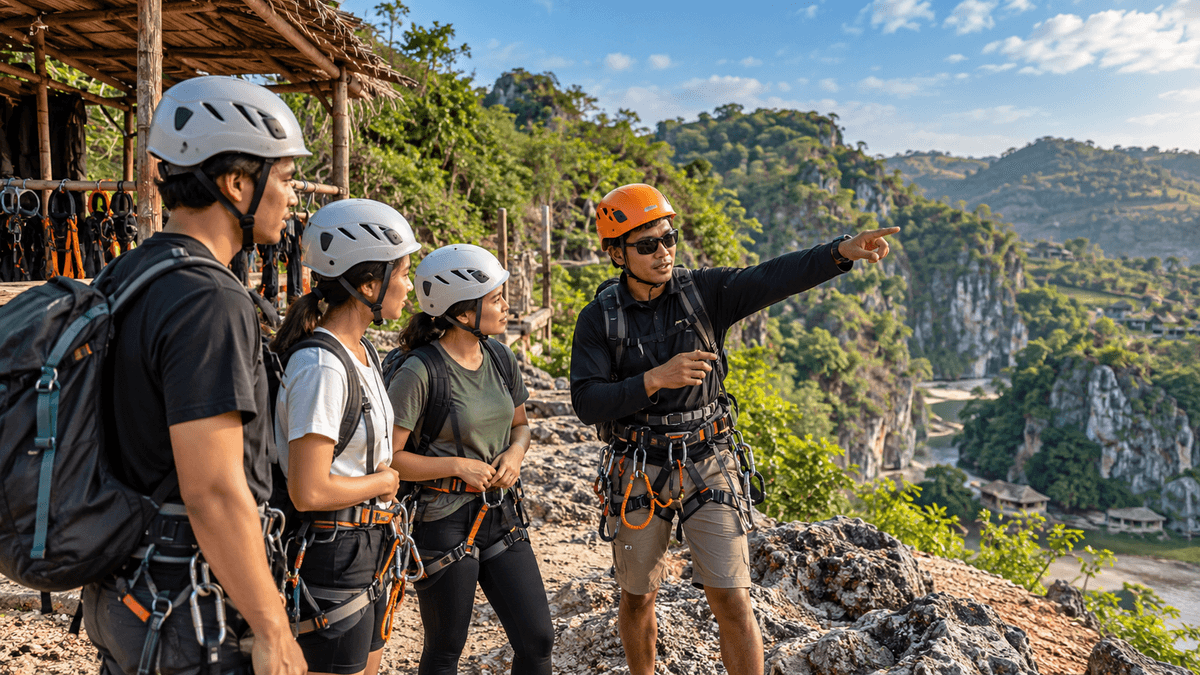
Adventure tourism covers several different businesses
Cave exploration, cave tubing, climbing, camping, and other outdoor activities may all be described as adventure tourism, but their economics differ substantially. They use different equipment, staffing patterns, safety systems, booking cycles, and maintenance schedules. An operator that can run one activity is not automatically prepared to offer another, and a destination's popularity does not establish that every new activity will earn an adequate return.
For Gunungkidul Regency, the relevant question is whether selected adventure products can attract customers at prices that support reliable operations, competent staff, equipment upkeep, and applicable safety requirements. A higher-value market takes more than a higher ticket price: customers must receive an experience worth paying for, and providers must retain enough revenue to sustain service quality across busy and quiet periods.
This article focuses on product economics and skilled service delivery. It does not attempt to re-state the broader ecological, water-resource, or carrying-capacity analysis addressed elsewhere in the Infowisata.id editorial series. Those constraints still matter at individual sites, but the business decision examined here is whether an operator can design and run a specific product responsibly and commercially.
The products have different cost structures
Cave tours and guided underground experiences
Cave-based products may rely on specialist guides, controlled group sizes, communication procedures, visitor equipment, access management, and a response plan suitable for the specific cave. The cost structure is therefore affected by how many customers can be served per guide, the time required for each tour, equipment life, and the consequences of equipment or staff unavailability.
A premium experience needs more than a high entrance fee. Its value should be supported by competent interpretation, a well-organized booking process, appropriate visitor screening where necessary, dependable equipment, and clear operating procedures. If the customer is paying for a specialist experience, the business must be able to explain what expertise and service are included.
Cave tubing and other equipment-led activities
Cave tubing has a different operating profile. Equipment must be prepared, checked, cleaned, stored, and replaced. Guides and support staff need clear role assignments, group-control procedures, visitor briefings, and incident-response arrangements appropriate to the activity. A package rate should account for the staff time and equipment cycle required to handle a booking rather than simply divide a target revenue by a maximum theoretical number of visitors.
Public listings can help travelers and researchers identify products, but price fields are not necessarily comparable. A listed package may include guides, transport, equipment, or other services that another operator charges separately. Published prices should not be used as a current market benchmark until the provider confirms the date, inclusions, minimum group size, and booking terms.
Climbing and other technical outdoor activities
Climbing, rope-based activities, and similar technical experiences rely on more specialized competence and equipment than a standard sightseeing tour. Costs may include rated equipment, inspection and retirement procedures, trained supervision, rescue capability, and a clear definition of which routes or activities are included. The number of participants that can be safely supervised at one time affects revenue capacity; increasing group size to improve margins may create unacceptable pressure on the operating model.
The investment question is whether a provider can generate adequate contribution from the volume that its staffing, equipment, site conditions, and relevant rules permit. Theoretical demand for a much larger group does not change that.
Camping and outdoor stays
Camping products may require less technical equipment per visitor than some guided cave experiences, but they still depend on site preparation, toilets, waste handling, lighting where appropriate, booking management, staff presence, guest communication, and clear limits on what the price includes. Operators also need a plan for weather changes, late arrivals, cancellations, and equipment damage.
Listings on Indonesia's Jadesta tourism platform show camping-related offerings such as Camping Gunung Api Purba and Camp Telaga Kemuning. These pages illustrate different possible product components; they should not be read as proof of current stock, quality, occupancy, or profitability. The Gunung Api Purba listing states that the displayed starting price covers the entrance fee and does not include a tent. A different package may include tent arrangements, a campfire, snacks, or a guide. That is why headline prices should not be compared without normalizing the inclusions. Jadesta: Camping Gunung Api Purba (opens in a new tab); Jadesta: Camp Telaga Kemuning (opens in a new tab).
A fair comparison begins with unit economics
Potential investors or operators need a separate model for each product. At minimum, the model should distinguish revenue per booking, variable cost per participant, contribution per booking, fixed operating costs, initial capital expenditure, equipment replacement, and the cost of complying with applicable requirements.
A simple starting point is:
Contribution per participant = net price received per participant − variable cost per participant.
Variable costs may include guide hours, equipment consumables, cleaning, transport, payment fees, and per-visitor supplies. Fixed costs may include base staffing, storage, regular inspections, training, insurance premiums where applicable, administration, maintenance facilities, and marketing. Capital costs should be assessed separately rather than hidden inside a loosely defined “operating expense.”
Break-even bookings = fixed operating costs over the period ÷ contribution per booking.
This calculation is only useful when its assumptions are realistic. Contribution per booking must account for the actual group size, required staffing, and full variable cost. If a business can usually serve six people per session but its financial model assumes twelve, the calculated break-even point will be misleading.
Public listings also show why headline prices should not be compared without checking inclusions. The Ministry of Tourism's Jadesta listing for Camping Gunung Api Purba in Nglanggeran states that camping starts at IDR 20,000 per person for admission without a tent, while also describing tent-inclusive packages. The Camp Telaga Kemuning listing describes a basic offer at IDR 10,000 per person for a pendopo, electricity, and water, but the same listing's separate “Harga Mulai Dari” field shows IDR 60,000. Both pages were checked on 26 October 2026; the figures are what the listings state, not independently quoted prices. The different inclusions and the two different price fields on the Telaga Kemuning page make these figures unsuitable for a direct price ranking without operator confirmation. Camping Gunung Api Purba (opens in a new tab); Camp Telaga Kemuning (opens in a new tab).
A credible feasibility model should test at least three scenarios:
| Scenario | Demand assumption | Cost and operating test | Question to resolve |
|---|---|---|---|
| Conservative | Lower bookings and more cancellations | Fixed costs still recur; maintenance continues | Can the activity remain financially solvent without cutting critical controls? |
| Base case | Expected bookings based on documented evidence | Normal staffing and maintenance cycle | Does the service generate enough contribution to fund reliable delivery? |
| High demand | More bookings during peak periods | Additional staff, equipment wear, queues, and schedule pressure | Can capacity expand safely, or will service quality deteriorate? |
An additional stress test should model equipment downtime, a weather-related closure, the loss of a trained guide, or a temporary suspension. The right response may be to reduce costs, diversify the product, improve booking management, or delay investment, but never to omit necessary safety spending from the model.
Guide skills are part of the product's value
Guiding involves more than narration. Depending on the activity, staff may need route preparation, group management, visitor interpretation, activity-specific technical skills, equipment checks, communication, first aid, and emergency-response competence. The exact qualification and staffing requirements should be matched to the activity and applicable rules.
Gunungkidul's Tourism Office reported that 30 participants took part in general guide training and competency testing held on 10-11 July 2024. The program covered preparation and delivery of guiding, safety and security management, interpretation, and emergency-handling practice. The report said participants who passed the competency test were expected to be able to obtain a general guiding license; it did not report the number who passed or establish how many currently operating adventure guides hold valid credentials. Nor does general guiding certification, by itself, establish specialist competence for every adventure activity. Source: Gunungkidul Tourism Office, published 22 July 2024 (opens in a new tab).
The distinction between general guiding and activity-specific competence is commercially important. A guide who can interpret a destination may still need additional training to operate a technical activity. Operators should map each job to its required skills, confirm credentials, document refresher training, and avoid assigning people to tasks outside their competence.
Competence also influences customer value. Accurate interpretation, clear explanations, orderly preparation, and calm handling of changes make a trip more dependable. Those qualities can support stronger pricing when customers can see what they receive. The business case does not rest on certification automatically raising revenue. Defined skills can improve service consistency, risk management, and the basis for a trustworthy product promise.
Apply regulations to the correct business classification
Minister of Tourism Regulation No. 6 of 2025, promulgated on 10 October 2025 and listed as in force by the Ministry's legal database, sets business standards and supervision arrangements for risk-based licensing in tourism. Its annex contains standards for KBLI 93223, Wisata Petualangan Alam (natural adventure tourism), including requirements related to the standard certificate, facilities, human resources, documented safety and risk management, first aid, and documented visitor life insurance. Official regulation record (opens in a new tab); full regulation and annex (opens in a new tab).
The relevant activity's actual licensing classification must be established before applying that specific standard. A public label such as “adventure,” “outdoor,” or “cave tubing” is not by itself proof of the business's KBLI classification or complete licensing status. Different activities may fall under different classifications or be delivered by separate entities. Operators should verify the current license, applicable standard, and evidence of compliance with the authority responsible for the activity.
The public sources reviewed do not establish the current registered operator, applicable business classification, current specialist credentials, insurance terms, equipment-maintenance status, or day-to-day operating conditions for every example activity. Those details should be verified before making an operator-specific legal or compliance statement. This market-level analysis does not claim that any named operator is compliant or noncompliant.
Site limits should inform the investment decision
Adventure tourism is site-dependent. Operating hours, access, weather, maintenance, available staff, and the physical characteristics of an activity may limit the number of services that can be sold. Those constraints should enter the feasibility model before an investor estimates revenue. Without turning this article into a general carrying-capacity analysis, the practical point is that the commercially deliverable volume is the volume the site and operation can responsibly handle.
For each proposed activity, a feasibility assessment should document the site owner or manager, permission to operate, available facilities, access and emergency arrangements, operating season, weather rules, staffing schedule, booking history, nearby alternatives, and competition. If those facts are unknown, projections should be presented as scenarios rather than forecasts. Where the required data is absent, the correct conclusion is that commercial feasibility remains unproven.
Comparable, current operator-level data on booking volume, price inclusions, variable costs, guide qualifications, equipment replacement, cancellations, insurance costs, and operating margins across Gunungkidul's cave, tubing, climbing, and camping products were not found in the public sources reviewed. Without such data, the products can be compared by operating requirements, but not ranked reliably by profitability. The sections above therefore set out a feasibility framework and evidence requirements instead of a ranking.
A practical development strategy
A realistic strategy would begin with a small number of products whose operators are prepared to disclose enough information for a basic business and readiness review. Each product should have a defined target customer, a clear service description, a normalized price structure, documented staffing requirements, an equipment maintenance plan, and a procedure for cancellations and incidents.
The destination or tourism office can support training, verified information, coordination, and access to relevant business guidance. Operators should own the reliability of their service and the records needed to demonstrate that reliability. Investors should require evidence of demand and permission to operate before committing to major capital expenditure. Any public support should be assessed against measurable outcomes such as completed bookings, competent staffing, supplier payments, customer complaints, safe delivery, and the financial resilience of the business.
A higher-value adventure market needs a smaller set of well-designed products that can command a defensible price because they deliver distinctive experiences through competent, reliable service. It does not need every site to expand or every operator to add more activities. For Gunungkidul, the first investment should often be in product definition, staff capability, operating discipline, and reliable data, ahead of any assumption that more equipment or a larger visitor target will create a viable business.
Sources consulted
- Ministry of Tourism of the Republic of Indonesia. Peraturan Menteri Pariwisata Nomor 6 Tahun 2025 tentang Standar Kegiatan Usaha, Tata Cara Pelaksanaan Pengawasan, dan Sanksi Administratif pada Penyelenggaraan Perizinan Berusaha Berbasis Risiko Sektor Pariwisata. Promulgated 10 October 2025; listed as in force. Checked 26 October 2026. https://jdih.kemenpar.go.id/peraturan/1422 (opens in a new tab)
- Ministry of Tourism of the Republic of Indonesia. Full text and annex of Minister of Tourism Regulation No. 6 of 2025, including standards for KBLI 93223, Wisata Petualangan Alam. Checked 26 October 2026. https://api-jdih.kemenpar.go.id/assets/32cfb027-78d5-4bd2-9dd7-7a46d440dae9 (opens in a new tab)
- Dinas Pariwisata, Ekonomi Kreatif, Pemuda, dan Olahraga Kabupaten Gunungkidul. “Pelatihan Dan Sertifikasi Pemandu Wisata Umum.” Published 22 July 2024. Checked 26 October 2026. https://wisata.gunungkidulkab.go.id/pelatihan-dan-sertifikasi-pemandu-wisata-umum/ (opens in a new tab)
- Jadesta, Ministry of Tourism of the Republic of Indonesia. “Camping Gunung Api Purba” (opens in a new tab) and “Camp Telaga Kemuning” (opens in a new tab). Checked 26 October 2026. These listings illustrate product components and published price presentation; prices and availability must be confirmed with the operator before use in a current market comparison.
Keep reading
Related articles: